What Is IELTS? It is an internationally recognised English-language test used by universities, employers, professional bodies and immigration authorities to assess a person’s ability to communicate in English. The right test depends on the organisation and purpose.
IELTS Full Form and Meaning
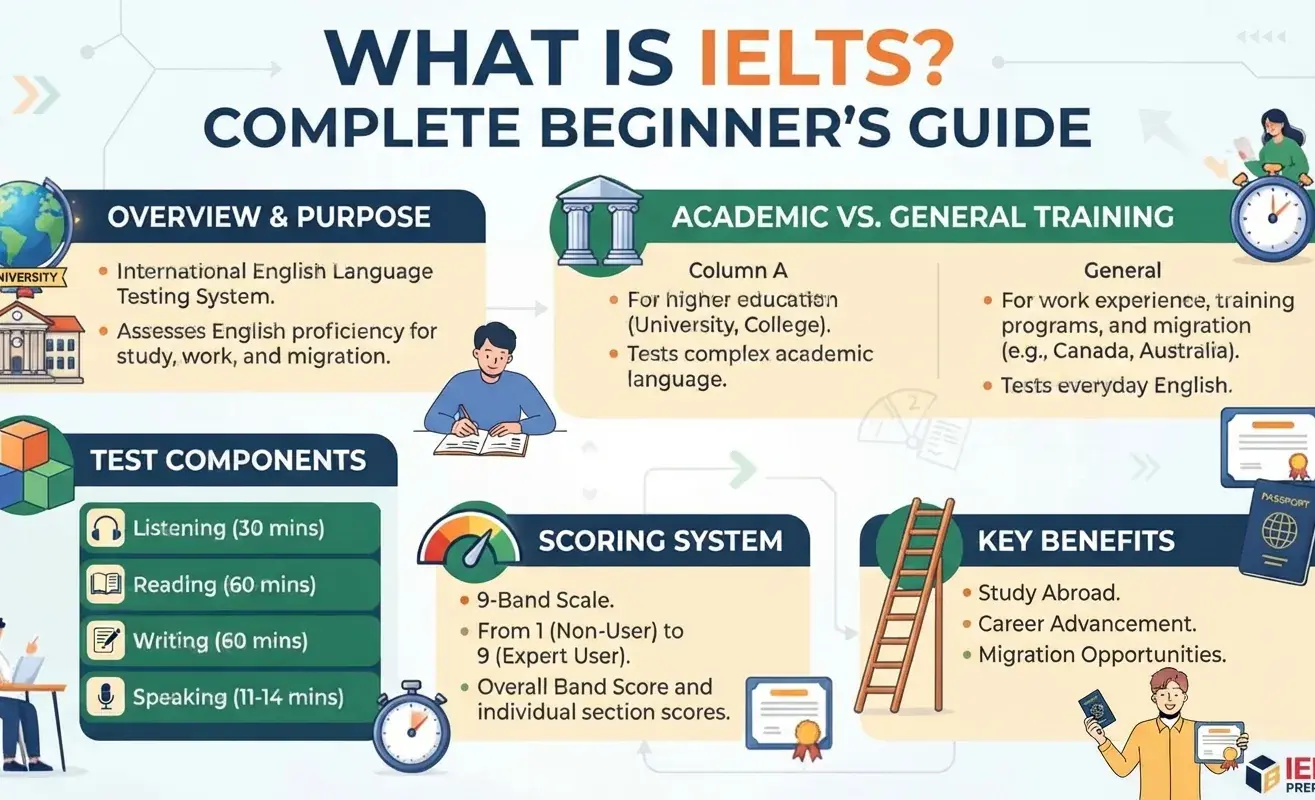
The IELTS full form is International English Language Testing System. It measures practical English ability, not knowledge of a school syllabus. In simple terms, it helps organisations assess how well an applicant communicates in academic, professional and everyday situations.
IELTS is jointly owned by the British Council, IDP IELTS and Cambridge University Press & Assessment. Organisations set their own score requirements, so check the rules for your application before booking.
Why Do People Take the IELTS Exam?
The IELTS exam provides evidence of English proficiency when an organisation sets a language requirement. Universities may require an overall band and minimum scores in individual skills; professional regulators and immigration authorities set their own rules. A result supports an application but does not guarantee admission, employment, registration or a visa.
Across the world, candidates commonly take IELTS for university admission, professional registration, employment-related requirements, training programmes and migration applications. The accepted test type and required score depend on the country, organisation and application route.
Higher Education
Undergraduate and postgraduate admission to English-taught programmes.
Work and Professional Registration
Language evidence for some jobs and professional regulators.
Migration Applications
Approved English-test evidence for eligible immigration routes.
Training and Other Study
English-language requirements for colleges, training and below-degree courses.
IELTS is not compulsory for every university, job or visa. Some organisations accept alternative tests or exemptions. Before paying, check the accepted test, minimum overall and skill scores, and result-age policy with the organisation.
Who Needs to Take IELTS?
You may need the test when a university, employer, professional regulator or immigration authority asks for proof of English ability. Typical candidates include:
- Students applying for undergraduate, postgraduate or other courses taught in English.
- Doctors, nurses and other professionals seeking registration where an English test is required.
- People applying for work, training or migration routes that accept or require an IELTS result.
- Applicants for scholarships or training programmes that accept IELTS, and people seeking a recognised measure of their English ability.
Check directly with the organisation receiving your application; requirements differ between courses, employers and visa routes.
IELTS Test Types: Academic vs General Training
The two main IELTS test types are Academic and General Training. Both assess four skills, with the same Listening and Speaking format but different Reading and Writing tasks. Choose the version required by your receiving organisation, not the one you assume is easier.
| Feature | IELTS Academic | IELTS General Training |
|---|---|---|
| Typical purpose | Higher education and some professional registration. | Migration, work, training and some below-degree study where accepted. |
| Reading | Academic-style texts. | Everyday and workplace texts. |
| Writing | Task 1 usually involves describing visual information; Task 2 is an essay. | Task 1 involves writing a letter; Task 2 is an essay. |
| Listening and Speaking | Same component format as General Training. | Same component format as Academic. |
What Is IELTS for UKVI?
IELTS for UK Visas and Immigration (UKVI) is a Secure English Language Test for specified UK visa purposes. IELTS for UKVI Life Skills assesses Speaking and Listening only. Not every UK application requires a UKVI version; check your visa route because versions are not automatically interchangeable.
For a detailed comparison, consult the official guide to IELTS test formats.
How Does the IELTS Exam Work?
The standard four-skill test takes approximately 2 hours and 45 minutes. Listening, Reading and Writing are normally completed in one sitting; Speaking may be scheduled on the same day or at another time arranged by the test centre.
| Component | Approximate time | What it assesses |
|---|---|---|
| Listening | About 30 minutes | Understanding spoken English, including conversations and spoken information. |
| Reading | 60 minutes | Reading comprehension, locating information and understanding ideas. |
| Writing | 60 minutes | Organising and expressing written ideas in two tasks. |
| Speaking | 11–14 minutes | Spoken communication in a structured interview with an examiner. |
Four recordings and 40 questions cover conversations, monologues and educational or training contexts. Practise identifying meaning and details across different accents.
Answer 40 questions. Academic uses academic-style passages; General Training uses everyday and workplace texts. Practise skimming, scanning and time management.
Two tasks in 60 minutes. Academic Task 1 describes visual information; General Training Task 1 is a letter. Task 2 is an essay in both versions. Organisation, relevant ideas, vocabulary and grammar matter.
A structured three-part examiner interview: familiar questions, an individual cue-card talk and a follow-up discussion. Assessment covers fluency, vocabulary, grammar and pronunciation.
The Speaking interview may be face-to-face or by video call, depending on the test centre’s approved arrangements.
Understanding IELTS Band Scores
IELTS results use a 0–9 band scale. You receive a score for each skill and an overall band calculated by averaging the four component scores and rounding to the nearest whole or half band. For example, 6.25 becomes 6.5, while 6.125 becomes 6.0.
| Band | Level | General description |
|---|---|---|
| 9 | Expert user | Fully operational command of English. |
| 8 | Very good user | Very strong command, with occasional unsystematic inaccuracies. |
| 7 | Good user | Good command, although some inaccuracies or misunderstandings may occur. |
| 6 | Competent user | Effective command despite some errors and misunderstandings. |
| 5 | Modest user | Partial command; can manage overall meaning in many situations. |
| 4 | Limited user | Basic ability in familiar situations. |
| 3 | Extremely limited user | Conveys and understands only general meaning in very familiar situations. |
| 2 | Intermittent user | Has great difficulty understanding spoken and written English. |
| 1 | Non-user | Can use only a few isolated words. |
| 0 | Did not attempt | Did not answer the test questions. |
There is no universal IELTS passing score. Each university, employer, professional regulator or immigration route sets its own requirements, and some ask for minimum scores in individual skills. Read the official IELTS band-score guide for detailed descriptions and scoring rules.
IELTS Test Delivery and Booking Options
IELTS delivery arrangements can differ by test type, location and test centre, and the options offered by providers may change over time. Depending on the place and purpose of the test, candidates may be offered computer-based testing at an approved centre, a writing-on-paper arrangement where officially available, or an online option for eligible test types and locations. No single format should be assumed to be available everywhere.
Computer-Based Testing
Where offered, candidates complete the relevant test sections on a computer at an approved test centre. The test still assesses the same core English skills: Listening, Reading, Writing and Speaking.
Writing on Paper or Other Paper-Based Arrangements
Some test locations or arrangements may include handwritten responses for the Writing section, even when other sections are completed on a computer. The exact format, eligibility and availability must be confirmed with the official provider.
Online Testing
An online test option may be available for certain test types and locations. Remote testing is not accepted for every purpose, so check both the test provider’s rules and the requirements of the organisation receiving your result.
Before booking, check the official IELTS information about ways to take the test, review the available IELTS test types, and use the official IELTS test-centre finder to confirm the formats offered for your location and purpose.
How to Prepare for IELTS as a Beginner
IELTS for beginners can feel challenging because it assesses several skills under time limits. Start by confirming your required score, then build a regular routine rather than memorising model answers.
- Confirm your target. Check whether you need Academic, General Training or UKVI, and note overall and individual skill scores.
- Check your level. Try a timed sample test to identify your strongest and weakest skills.
- Learn the format. Understand instructions, task types, timing and marking criteria before full mock tests.
- Build daily habits. Listen to English, read articles, write regularly and practise speaking aloud. Review grammar, vocabulary, organisation and clarity.
- Practise under time limits. Use sample questions and mock tests, then keep a record of spelling, grammar and timing mistakes.
Frequently Asked Questions
What does IELTS stand for?
IELTS stands for International English Language Testing System. It assesses Listening, Reading, Writing and Speaking.
Is IELTS difficult for a beginner?
It can be demanding if you are new to English tests, but learning the format and practising each skill consistently can make preparation more manageable.
Can I prepare for IELTS at home?
Yes. You can prepare independently with reliable study materials, a realistic timetable, regular speaking practice and timed sample tests. Practising at home is different from taking the official test remotely.
Can I take IELTS at home?
An online test option may be available for eligible test types and locations, but it is not accepted for every purpose. Check the official provider and the organisation receiving your result before booking. Where an application requires an approved Secure English Language Test, confirm that the specific online option meets that requirement.
Which IELTS version should I choose?
Choose the version required by the university, employer, professional body or visa route you are applying to. Do not assume Academic, General Training and UKVI versions are interchangeable.
Does IELTS have a passing score?
No universal pass mark applies. IELTS reports band scores; the receiving organisation sets the overall and any individual-skill scores it requires.
How long is an IELTS result valid?
IELTS recommends that results are considered valid for two years. The receiving organisation decides whether it will accept an older score, so check its policy.
Can I take General Training for university admission?
Only if the university and programme specifically accept it. Many higher-education courses ask for Academic, so check the programme’s official English-language requirements before booking.
Is the computer-delivered test easier?
The skills, question types and scoring standards are intended to be the same. The difference is how you view questions and enter answers; comfort with screens and typing may affect which available option suits you.
Conclusion
IELTS helps organisations assess English ability for education, professional and migration-related applications. Understand the test version, four components, duration and band-score system, then confirm the requirements that apply to your application. Consistent practice with reliable resources can help you prepare with confidence.

Recent Comments