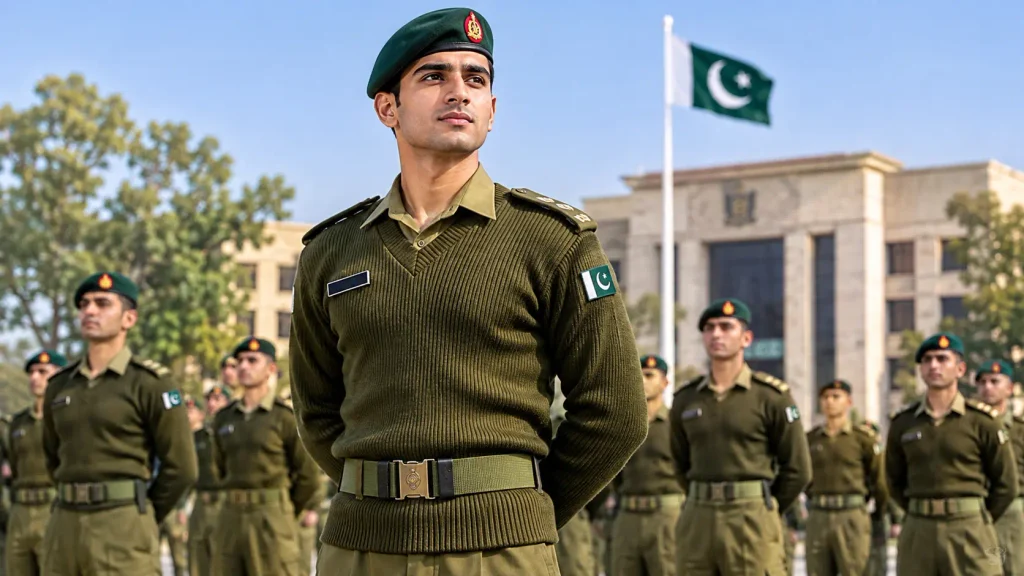
Preparing for the PMA Long Course Initial Test Syllabus is easier when you understand the abilities and school subjects you may be asked to demonstrate at your Army Selection and Recruitment Centre (AS&RC). The preliminary written and intelligence assessment is an early stage of selection, so prepare for both reasoning questions and academic MCQs.
Overview of the PMA Initial Test Pattern
The commonly reported PMA initial test pattern has three broad parts. Candidates should be ready for verbal reasoning, visual or figure-based reasoning, and an academic section. The assessment is generally described as computer-based at Army Selection and Recruitment Centres, but candidates should follow the format and reporting instructions printed on their own test slip.
| Test section | Main purpose | Typical preparation areas |
|---|---|---|
| Verbal intelligence | Checks word-based reasoning and logical thinking | Series, analogies, coding, relationships and directions |
| Non-verbal intelligence | Checks visual reasoning and pattern recognition | Figures, matrices, sequences, rotations and mirror images |
| Academic test | Checks school-level knowledge | English, mathematics, Pakistan Studies, Islamiyat and general knowledge |
Some preparation guides also include general science, current affairs or additional subject areas. Treat these as useful revision topics rather than a guarantee that every subject will appear in the same paper. Exact question numbers, marks and section timings should not be assumed from an academy handout or an older course guide.
Verbal Intelligence Test Topics
The verbal section measures how accurately and quickly you understand written information. The PMA verbal intelligence test syllabus commonly discussed by preparation sources includes short reasoning questions that can be solved through patterns, relationships and basic logic.
Important verbal reasoning areas
- Number and alphabet series: Find the next number or letter by identifying the sequence rule.
- Analogies: Recognise the relationship between two words and apply the same relationship to another pair.
- Odd one out: Select the word, number or item that does not fit the common group.
- Coding and decoding: Work out how letters or words have been changed according to a rule.
- Blood relations: Understand family relationships from a short statement.
- Directions and position: Follow movement, turns and location-based clues.
- Word order and vocabulary: Use alphabetical order, simple meanings and dictionary-style arrangement.
Practise with a timer, but do not rush so much that you miss a simple clue. Read each question carefully, identify what it is asking, and eliminate options that clearly do not match the pattern.
Non-Verbal Intelligence Test Topics
The non-verbal section uses shapes and figures instead of sentences. It tests whether you can recognise a visual rule and apply it to a new diagram. Candidates often find this section difficult at first because it requires regular practice rather than memorising definitions.
Common figure-based question types
- Complete a sequence by choosing the missing figure.
- Identify changes in shape, size, direction, shading or number of objects.
- Compare mirror images and rotated figures.
- Find a hidden or embedded shape within a larger diagram.
- Complete a figure matrix by identifying the relationship between rows and columns.
- Recognise symmetry, spatial position and basic diagram patterns.
For each practice question, check one feature at a time: direction, number of lines, shaded areas, rotation or position. This simple method helps you avoid guessing when several figures look similar.
Academic Test Subjects and Topics
The academic section is based on foundational school knowledge. For the PMA academic test syllabus, begin with the subjects most consistently listed in preparation material and revise your Matric and Intermediate concepts. The exact weight given to each subject may differ between intakes.
| Subject | Topics to revise |
|---|---|
| English | Parts of speech, tenses, articles, prepositions, subject-verb agreement, synonyms, antonyms and sentence correction. |
| Mathematics | Fractions, percentages, ratios, averages, profit and loss, basic algebra, number operations and simple geometry. |
| Pakistan Studies | Pakistan Movement, important national events, geography, provinces, national institutions and basic constitutional knowledge. |
| Islamiyat | Fundamental beliefs, pillars of Islam, Seerah, important events in Islamic history and basic religious knowledge. |
| General Knowledge | World geography, capitals, international organisations, important personalities, sports and major national or international developments. |
| General Science | Basic physics, chemistry, biology and everyday science concepts where included in the relevant preparation material. |
Do not prepare only from guess papers. Use your textbooks and concise notes to understand the basics, then solve topic-wise PMA initial test MCQs to check your knowledge. Keep a separate list of incorrect answers and revise it regularly.
How to Prepare for the Initial Test
A balanced routine is more useful than studying one subject for long hours and ignoring the others. Set a daily target for both intelligence practice and academic revision. Adjust the plan according to your current strengths and the time available before your test date.
- Build a daily intelligence routine: Practise verbal questions and non-verbal figures every day. Focus on accuracy first, then gradually improve your speed.
- Revise academic basics: Give regular time to English, mathematics, Pakistan Studies, Islamiyat and general knowledge. Review general science as an additional area where relevant.
- Attempt timed practice sets: Complete mixed MCQ sets without checking answers after every question. Review the full set when you finish.
- Maintain an error notebook: Write down questions you answered incorrectly and the reason for each mistake.
- Practise on a computer: Become comfortable reading questions and selecting options on-screen, especially if your centre uses computer-based testing.
- Prepare calmly for test day: Check your roll-number slip, reporting time and required documents in advance. Follow the instructions issued by your centre.
Practise by subject: Use ExamChamber’s subject resources to revise key concepts and test yourself with relevant questions.
Explore Practice SubjectsYou can also work on intelligence test and IQ practice to improve reasoning speed.
What Happens After the Written and Intelligence Test?
Passing the initial assessment does not mean that selection is complete. The preliminary process can include further medical checks, physical assessment and an interview at the relevant AS&RC. Candidates who progress may then be considered for ISSB, where suitability for officer training is assessed through a broader selection process.
For current recruitment dates, eligibility, documents and test instructions, use the official Pakistan Army recruitment website. For information about the later selection-board stage, consult the official Inter Services Selection Board website. Always give priority to the latest official instructions issued for your course.
Frequently Asked Questions
What are the main PMA initial test subjects?
The commonly reported sections are verbal intelligence, non-verbal intelligence and an academic test. Academic preparation generally covers English, mathematics, Pakistan Studies, Islamiyat and general knowledge. Some guides also recommend revising general science.
Is the PMA initial test computer-based?
Recent PMA recruitment guidance describes computer-based testing at Army Selection and Recruitment Centres. Follow the instructions on your own roll-number slip because the assigned centre provides the applicable test arrangements.
How many questions and how much time are given?
Do not rely on a fixed number or duration shared by an unofficial website. A single verified public 2026–27 blueprint covering every section was not available in the material reviewed. Use the current instructions provided by the Army for your test.
Are verbal and non-verbal intelligence tests difficult?
They can feel challenging without practice, but regular work on series, analogies, coding, figure patterns and matrices can improve speed and accuracy. Start with simple questions and increase difficulty gradually.
Can I prepare for the test at home?
Yes. You can revise school subjects, solve practice MCQs and practise reasoning questions at home. However, use official recruitment instructions for test-day requirements and do not treat unofficial guess papers as the actual examination.
Final Preparation Advice
Successful preparation depends on understanding the test areas, practising consistently and revising mistakes. Give equal attention to reasoning and academic knowledge, improve your computer familiarity, and avoid depending on unverified claims about exact paper timings or question counts. Check the official recruitment portal regularly so your preparation and test-day arrangements match the instructions for your course.

Recent Comments