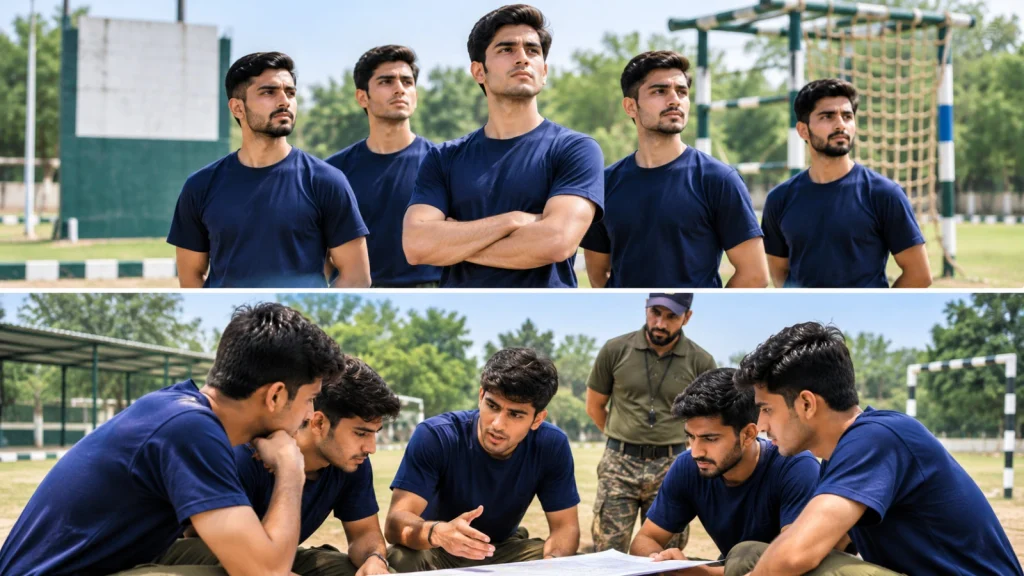
ISSB GTO Tasks are an important part of the selection process for candidates who want to become commissioned officers in the Pakistan Armed Forces. GTO stands for Group Testing Officer, and these assessments provide opportunities for candidates to demonstrate teamwork, communication, leadership, confidence and practical thinking.
What Are GTO Tasks in ISSB?
GTO tasks are assessment activities conducted under the supervision of a Group Testing Officer. They allow the selection board to observe how candidates interact with others, communicate ideas, make decisions and respond to different situations.
Unlike a traditional written examination, these activities involve practical participation and interaction with other candidates. The purpose is to understand a candidate’s personality and potential for future leadership.
What Is the Role of a Group Testing Officer?
A Group Testing Officer supervises group assessment activities and observes the behaviour and participation of candidates. The GTO evaluates how individuals contribute to the group and respond to different responsibilities.
Candidates are observed in different situations, including discussions, planning exercises and supervised outdoor activities.
Complete List of ISSB GTO Tasks
Candidates commonly encounter the following activities in ISSB preparation material. The actual assessment programme should always be confirmed through official ISSB instructions.
| GTO Task | Assessment Focus |
|---|---|
| Group Discussion (GD) | Communication and reasoning |
| Group Planning Exercise (GPE) | Planning and decision-making |
| Progressive Group Task (PGT) | Teamwork and cooperation |
| Half Group Task (HGT) | Individual contribution within a team |
| Lecturette | Public speaking and confidence |
| Individual Obstacles | Physical confidence and determination |
| Command Task (CT) | Leadership and responsibility |
| Final Group Task (FGT) | Team spirit and coordination |
1. Group Discussion (GD)
Group Discussion is an activity in which candidates discuss a given subject with other members of their group. Topics may relate to education, society, current affairs, technology and other general issues.
What Does Group Discussion Assess?
- Communication skills.
- Confidence while expressing opinions.
- Listening and understanding abilities.
- Logical thinking and reasoning.
- Respect for different viewpoints.
- Participation in group conversation.
- Importance of Education in Pakistan
- Social Media: Advantages and Disadvantages
- Role of Youth in National Development
- Importance of Discipline
- Technology and Modern Education
Candidates should express their ideas clearly, listen to others and maintain respectful communication. Speaking loudly or interrupting others does not automatically demonstrate leadership.
2. Group Planning Exercise (GPE)
The Group Planning Exercise is also known as a Military Planning Exercise in ISSB preparation material. Candidates are presented with a situation containing different problems and limited information or resources.
They are expected to understand the situation, identify important issues and contribute to a sensible group discussion about possible solutions.
What Does GPE Assess?
- Analytical thinking.
- Understanding of a situation.
- Prioritising important information.
- Decision-making ability.
- Team coordination.
- Clear explanation of ideas.
3. Progressive Group Task (PGT)
Progressive Group Task is an outdoor group assessment. Candidates work together in a supervised environment involving different obstacle-based challenges.
The activity is designed to observe how members cooperate, share responsibilities and communicate while working towards a common objective.
What Does PGT Assess?
- Teamwork and cooperation.
- Participation in group activities.
- Practical thinking.
- Communication with team members.
- Responsibility towards others.
- Ability to remain composed under pressure.
Candidates should follow the GTO’s instructions and safety rules. Outdoor assessment activities must only be performed under the supervision of authorised staff.
4. Half Group Task (HGT)
Half Group Task is another group-based outdoor assessment. In this activity, the original group is divided into smaller groups for a separate assessment.
With fewer members participating at one time, the individual contribution of each candidate can become more noticeable.
What Does HGT Assess?
- Individual participation.
- Cooperation with a smaller team.
- Communication and coordination.
- Confidence in expressing ideas.
- Responsibility and teamwork.
5. Lecturette
Lecturette is a short speaking activity in which a candidate is asked to speak on a selected topic in front of other candidates or the assessment staff, according to the instructions provided.
It provides an opportunity to demonstrate communication skills, confidence and the ability to organise thoughts.
Possible Lecturette Topics
- Importance of Time Management
- Pakistan’s Education System
- Climate Change
- Importance of Sports
- Artificial Intelligence
- Role of Youth in Pakistan
- National Unity
What Does Lecturette Assess?
- Public speaking confidence.
- Organisation of ideas.
- Vocabulary and communication.
- General awareness.
- Ability to explain a topic clearly.
6. Individual Obstacles
Individual Obstacles are physical assessment activities conducted in a supervised outdoor environment. Unlike group tasks, candidates are assessed individually.
These activities provide an opportunity for the GTO to observe physical confidence, determination and participation in a challenging assessment environment.
What Does Individual Assessment Observe?
- Physical confidence.
- Determination and persistence.
- Self-confidence.
- Alertness.
- Ability to follow instructions.
- Awareness of personal safety.
7. Command Task (CT)
Command Task is an individual leadership assessment conducted within a group setting. A candidate is assigned a leadership responsibility and is expected to communicate with selected team members while addressing the given task.
This activity allows the GTO to observe how a candidate takes responsibility, communicates decisions and works with others.
What Does Command Task Assess?
- Leadership qualities.
- Confidence and responsibility.
- Decision-making ability.
- Communication skills.
- Cooperation with team members.
- Ability to remain calm under pressure.
Effective leadership also involves listening to team members and treating them respectfully. A good leader does not need to dominate every conversation.
8. Final Group Task (FGT)
Final Group Task is a group-based outdoor assessment commonly described in ISSB preparation resources as the concluding activity of the GTO outdoor tasks.
Candidates work together in a supervised assessment environment. The activity provides another opportunity to observe cooperation, group participation and coordination.
What Does FGT Assess?
- Team spirit.
- Mutual cooperation.
- Group communication.
- Participation and responsibility.
- Respect for other candidates.
Which Qualities Does the GTO Observe?
The purpose of GTO activities is not simply to identify the most physically active or most talkative candidate. The selection board considers different aspects of personality and behaviour.
| Quality | Meaning |
|---|---|
| Leadership | Taking responsibility and guiding others appropriately. |
| Confidence | Expressing thoughts without unnecessary hesitation. |
| Cooperation | Working respectfully with other candidates. |
| Communication | Sharing information in a clear manner. |
| Decision Making | Understanding situations and making sensible choices. |
| Social Adaptability | Adjusting positively to different people and situations. |
| Responsibility | Taking ownership of assigned duties. |
| Self Confidence | Maintaining composure in assessment situations. |
How to Prepare for ISSB GTO Tasks
Preparation should focus on developing genuine personal qualities rather than memorising artificial responses. Candidates should build communication, awareness, responsibility and teamwork through ordinary educational and supervised group activities.
1. Improve Communication Skills
Read useful articles, discuss educational subjects and practise explaining your opinions clearly in Urdu and English.
2. Develop General Knowledge
Stay informed about Pakistan, education, science, technology, international developments and current affairs.
3. Participate in Team Activities
Take part in suitable school, college and community activities where you can learn cooperation and responsibility.
4. Develop Self-Confidence
Learn to express your ideas respectfully and accept constructive feedback. Confidence should come from genuine understanding rather than memorised statements.
5. Follow Safe Fitness Practices
Maintain a balanced daily routine, get sufficient rest and follow age-appropriate physical activity guidance. Any specialised physical assessment should be performed only in an authorised and supervised environment.
Common Mistakes Candidates Should Avoid
- Interrupting other candidates during discussions.
- Trying to dominate every group activity.
- Ignoring instructions given by the GTO.
- Showing disrespect towards other candidates.
- Giving memorised or artificial answers.
- Making unrealistic claims about personal abilities.
- Ignoring safety instructions during outdoor assessments.
- Comparing personal performance with every other candidate.
Official ISSB Guidelines for Candidates
The official ISSB guidelines emphasise clear thinking, calm behaviour under stress, teamwork, communication skills and honest participation. Candidates are also advised against artificial behaviour and excessive dependence on private coaching centres.
For the most accurate information, candidates should review the official selection system and guidelines before attending their assessment.
Read the official selection procedure and candidate guidelines directly from the Inter Services Selection Board.
ISSB Selection SystemOfficial ISSB Guidelines
Frequently Asked Questions
1. What does GTO stand for in ISSB?
GTO stands for Group Testing Officer. The GTO supervises group assessment activities and observes candidate participation and behaviour.
2. How many GTO tasks are conducted at ISSB?
Preparation resources commonly describe several indoor and outdoor activities, including group discussion, group planning, PGT, HGT, lecturette, individual obstacles, command task and final group task. The actual programme may vary.
3. What is Progressive Group Task?
PGT is a supervised outdoor group assessment in which candidates work together on obstacle-based challenges. It helps assess cooperation, participation and teamwork.
4. What is the difference between PGT and HGT?
Both are group-based outdoor assessment activities. PGT involves the larger group, whereas HGT involves a smaller divided group.
5. What is a Command Task in ISSB?
Command Task is an individual leadership assessment in which a candidate receives responsibility for working with a small team on an assigned task.
6. Is physical fitness important for GTO tasks?
Physical confidence and participation are relevant to outdoor assessments. Candidates should follow official safety instructions and appropriate fitness guidance.
7. Does the GTO only assess physical strength?
No. GTO activities provide opportunities to observe teamwork, communication, confidence, planning, leadership and other personal qualities.
8. Can I prepare for ISSB GTO tasks at home?
You can develop communication, general knowledge, confidence and teamwork through normal educational activities. Physical assessment obstacles should never be attempted without authorised supervision.
Conclusion
ISSB GTO tasks are an important part of the selection process for candidates aspiring to become officers in the Pakistan Armed Forces. Activities such as Group Discussion, Group Planning, Progressive Group Task, Half Group Task, Lecturette, Individual Obstacles, Command Task and Final Group Task provide different opportunities to assess candidate qualities.
The best approach is to develop genuine confidence, communication, teamwork, responsibility and self-awareness. Candidates should remain honest, respectful and attentive throughout the assessment process.
Find more recruitment guides, ISSB preparation resources, educational articles and study materials on ExamChamber.
Explore ExamChamberDisclaimer: ExamChamber is an independent educational information website and is not affiliated with the Inter Services Selection Board or Pakistan Armed Forces. Assessment arrangements may change. Always follow the latest official ISSB instructions.

Recent Comments