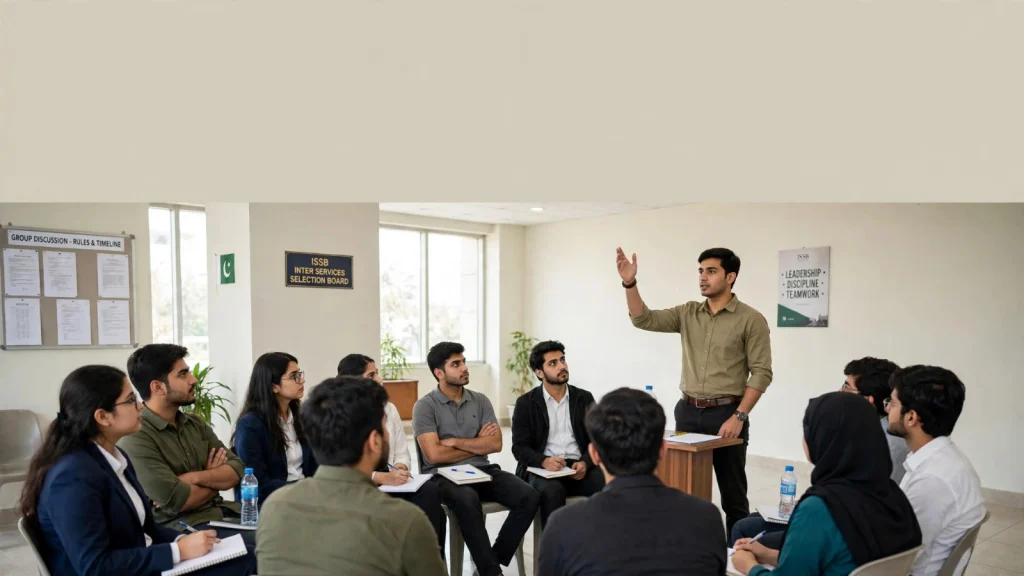
ISSB Group Discussion and Lecturette are communication activities that help candidates demonstrate how they share ideas, listen to others and explain a subject clearly. For Pakistani students preparing for the Inter Services Selection Board, understanding these activities can make preparation more focused and less stressful. The aim is to develop genuine communication skills, not to memorise speeches or imitate another candidate.
What Is Group Discussion in ISSB?
A group discussion is a structured conversation in which candidates exchange views on a subject provided by the assessment staff. Topics may relate to education, society, technology, national development or general awareness. Candidates are expected to contribute relevant points while allowing others to speak.
The activity is not a contest to see who speaks the loudest or for the longest time. A useful contribution is clear, connected to the topic and supported by a sensible reason or example. Listening carefully is just as important as expressing an opinion.
What Does Group Discussion Help Assess?
Group discussions give assessors an opportunity to observe several communication and interpersonal qualities, including:
- Clear communication: Explaining an idea in understandable language.
- Logical thinking: Connecting an opinion with relevant reasons.
- Listening: Paying attention to different viewpoints before responding.
- Cooperation: Helping the conversation remain constructive.
- Confidence: Sharing a view calmly without unnecessary hesitation.
- General awareness: Showing a reasonable understanding of the subject.
How Does an ISSB Group Discussion Generally Work?
The exact arrangement, language, number of topics and time allowed should be taken from the instructions issued at the assessment centre. The table below describes the broad idea of the activity, not a guaranteed timetable.
| Part | General explanation |
|---|---|
| Group arrangement | Candidates are brought together for a group activity. |
| Topic | The assessor provides the subject or instructions for discussion. |
| Exchange of views | Participants share relevant opinions and respond to points raised by others. |
| Observation | Communication, listening, reasoning and participation may be observed. |
Common Group Discussion Topics for Practice
The following are practice ideas for building general awareness. They are not an official, fixed or guaranteed list of ISSB topics.
Education and society
- Why education matters for Pakistan’s development
- The role of young people in community life
- Benefits and challenges of social media
- Why technical and vocational education is important
Technology and the environment
- Artificial intelligence in education
- Responsible use of mobile phones
- Climate change and everyday responsibility
- Cybersecurity awareness for students
National and global awareness
- Importance of national unity
- Employment opportunities for young people
- Good governance and public responsibility
- The role of media in sharing information
What Is Lecturette in ISSB?
Lecturette is an individual speaking activity in which a candidate gives a short talk on a selected subject, following the instructions provided by the assessment staff. Unlike group discussion, it focuses on how one person organises and presents ideas to an audience.
A good short talk has a clear beginning, a few relevant points and a brief conclusion. The purpose is not to use difficult vocabulary. Simple, accurate language is usually more effective than complicated sentences that are difficult to deliver naturally.
How to Structure a Short Lecturette
Preparation time and speaking duration can depend on the current assessment instructions. Rather than relying on an old online timetable, listen carefully to the directions given on the day. For practice, use this simple structure:
- Introduction: Explain the topic in one or two sentences.
- Main points: Present two or three relevant ideas, with a brief example if useful.
- Conclusion: Restate the central message and finish clearly.
Lecturette Topics to Practise
- Importance of discipline
- My educational goals
- Time management for students
- Reading habits and lifelong learning
- Environmental protection
- Teamwork and shared responsibility
- Leadership through service
- Honesty in everyday life
- Sports and student development
- Technology in modern education
Group Discussion vs Lecturette
| Group Discussion | Lecturette |
|---|---|
| Several candidates exchange ideas. | One candidate presents a short talk at a time. |
| Listening and responding are central. | Organising and presenting ideas are central. |
| Cooperation and respectful participation matter. | Clarity, structure and audience communication matter. |
| Different viewpoints are explored. | One subject is explained by the speaker. |
How to Prepare in a Practical Way
For candidates in Pakistan, regular practice can be built into normal school, college and home routines. Focus on understanding topics and communicating honestly rather than memorising ready-made answers.
- Read reliable news and educational sources to build awareness of current affairs.
- Choose one everyday topic and explain your view aloud in clear, simple sentences.
- Discuss educational subjects with classmates and practise listening without interrupting.
- Support opinions with relevant facts or examples, and admit when you do not know something.
- Practise speaking in Urdu and English as appropriate, while following the assessor’s language instructions during the actual activity.
- Ask a teacher or trusted classmate for constructive feedback on clarity and organisation.
Common Mistakes to Avoid
- Interrupting or speaking over other participants.
- Repeating the same point without adding anything useful.
- Giving an answer that is unrelated to the topic.
- Using memorised speeches that do not fit the subject.
- Trying to sound impressive with vocabulary you do not normally use.
- Presenting guesses as facts instead of being accurate and honest.
- Ignoring the instructions or time guidance provided by the assessor.
What Qualities Does ISSB Emphasise?
The official ISSB candidate guidance highlights clear thinking, the ability to remain calm under stress, teamwork, willingness to participate and good communication. It also advises candidates to be honest and straightforward rather than displaying artificial behaviour. These principles are useful when preparing for both speaking activities.
| Quality | How it can appear in communication |
|---|---|
| Clear thinking | Making a relevant point and explaining its reason. |
| Teamwork | Giving others room to contribute and responding respectfully. |
| Composure | Speaking calmly when opinions differ. |
| Communication | Using understandable language and an organised explanation. |
| Honesty | Sharing genuine views and avoiding unsupported claims. |
Official ISSB Guidance
Read the official ISSB candidate guidelines for advice about communication, confidence, teamwork and natural behaviour. You can also review the official ISSB selection system. The board explains that its assessment activities may be adjusted to meet the requirements of the Armed Forces, so current instructions should take priority over unofficial preparation schedules.
For related preparation on ExamChamber, explore the ISSB GTO tasks guide and the ISSB test preparation guide.
Preparing for your ISSB assessment?
Use official instructions as your main reference and build communication skills through regular reading, discussion and speaking practice.
Visit the official ISSB websiteFrequently Asked Questions
1. What is Group Discussion in ISSB?
It is a group communication activity in which candidates discuss a given subject, exchange views and respond to one another. The exact format is set by the assessment staff.
2. What is Lecturette in ISSB?
Lecturette is an individual speaking activity in which a candidate presents a short talk on a selected topic according to the instructions provided.
3. What is the main difference between Group Discussion and Lecturette?
Group Discussion involves an exchange of ideas among participants, while Lecturette focuses on one candidate presenting an organised explanation.
4. Which language should candidates use?
Follow the language instructions given by the assessor. Do not assume that an older online guide describes the current requirements.
5. Are practice topics guaranteed to appear?
No. Practice topics are only examples to help build general awareness. The actual subject may be different.
6. Does speaking more mean a better performance?
No. Relevant contributions, clear reasoning, listening and respectful participation are more useful than speaking continuously.
7. How can students improve their Lecturette skills?
Practise explaining familiar subjects with a short introduction, a few main points and a conclusion. Ask for feedback on clarity and accuracy.
8. Where can candidates find reliable ISSB information?
Use the official ISSB website and follow the latest instructions issued with your assessment details.
Conclusion
Group Discussion and Lecturette give candidates different ways to demonstrate communication and awareness. Group Discussion involves listening and exchanging opinions, while Lecturette requires an individual to organise and present a short talk. Both become easier with regular reading, thoughtful discussion and clear expression.
Prepare by developing genuine skills rather than memorising scripts. Be respectful, stay attentive to the instructions and use the official ISSB website as your main source for current information.

Recent Comments