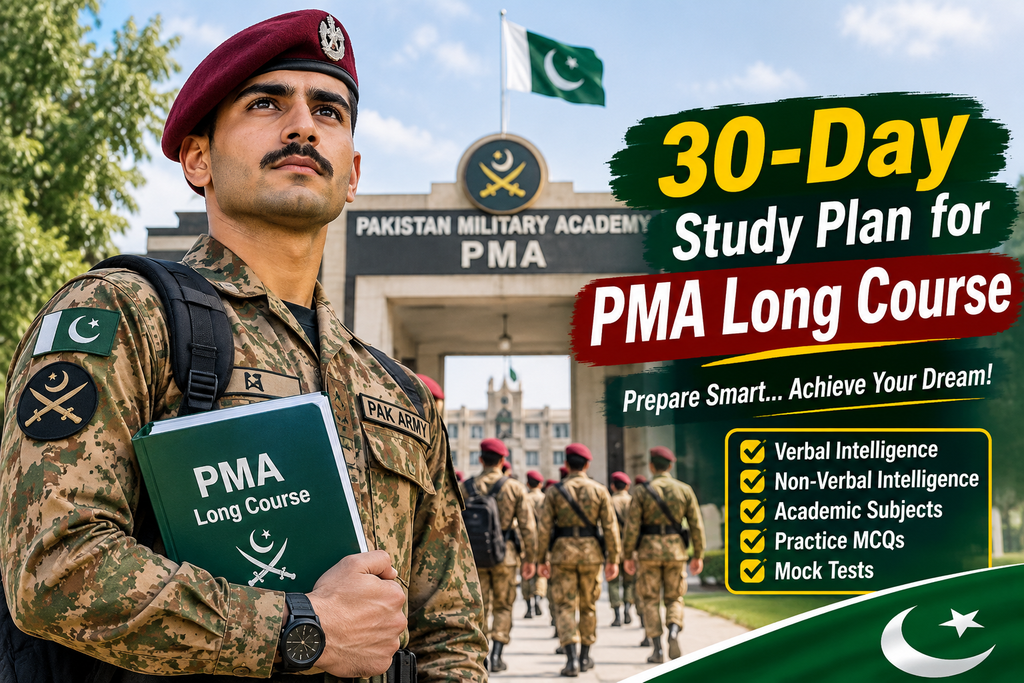
This 30-Day Study Plan for PMA Long Course – Complete Preparation Guide helps Pakistani candidates organize intelligence practice, academic revision, fitness and final review. It is designed as a practical month-long routine for students who want to prepare consistently instead of relying on last-minute cramming.
Understand the areas you need to prepare
A balanced PMA Long Course Preparation Plan should cover three areas: intelligence questions, academic knowledge and personal fitness. Candidates should also build confidence, communication and general awareness for later selection stages. The current ExamChamber PMA Long Course guide explains the broader process and provides a useful starting point.
Verbal and non-verbal intelligence
Verbal questions test how you understand relationships between words, numbers and ideas. Practise analogies, classification, letter and number sequences, coding and decoding, and short logical problems. PMA Verbal Intelligence Test Preparation should focus on understanding the rule behind an answer, not memorising a solved question.
Non-verbal questions use figures, shapes and visual patterns. Work on figure series, pattern completion, rotations, mirror images and identifying the different figure. For PMA Non Verbal Intelligence Test Preparation, begin untimed so you learn each pattern type, then gradually add a time limit.
Academic subjects
For PMA Academic Test Preparation, revise the academic areas specified for your course and candidate category. Common preparation areas include English, basic mathematics, Pakistan Studies, Islamic Studies and general knowledge. Strengthen grammar, vocabulary, comprehension, arithmetic, percentages, fractions and core facts before moving to mixed MCQ practice. Do not assume that an old syllabus or a preparation website overrides the latest official instructions.
Fitness and personal readiness
Do not leave running and strength work until the final week. Build gradually with suitable warm-ups, controlled exercise and recovery days. Also practise explaining your education, interests and motivation in clear Urdu and English; later stages may assess communication and personal qualities as well as test performance.
Your daily study routine
Use the following PMA Long Course Study Schedule as a flexible template. Adjust the duration around college, university, work or family responsibilities. Two focused sessions are usually easier to maintain than one long session filled with distractions.
| Study block | Suggested time | What to do |
|---|---|---|
| Verbal intelligence | 30 minutes | Practise word relationships, series, coding and reasoning. |
| Non-verbal intelligence | 30 minutes | Solve figure patterns and visual reasoning questions. |
| Academic revision | 45–60 minutes | Study one subject, then solve a short set of MCQs. |
| Review and current affairs | 20 minutes | Update your error notebook and read a reliable news summary. |
| Physical activity | 20–30 minutes | Follow a gradual running, mobility or strength routine. |
These times are recommendations, not official test timings. Take short breaks and protect your sleep so that the routine remains sustainable.
30-day preparation timetable
This 30 Days PMA Test Preparation roadmap moves from basic concepts to timed practice. Keep a notebook with three columns: question or topic, reason for the mistake, and the correct method. Review it at the end of each week.
Week 1: Build your foundation
| Day | Focus | Tasks |
|---|---|---|
| Day 1 | Initial assessment | Attempt a short mixed practice set. Note your strongest and weakest areas and set a realistic daily study time. |
| Day 2 | English and verbal basics | Revise grammar and vocabulary; practise analogies, word relationships and classification. |
| Day 3 | Mathematics | Revise fractions, percentages, ratios, averages and basic calculations; solve practice MCQs. |
| Day 4 | Pakistan Studies | Review key historical developments, geography and important national facts from reliable study material. |
| Day 5 | Islamic Studies | Revise core concepts, important events and commonly taught Islamic Studies topics. |
| Day 6 | General knowledge | Study basic science, geography, national information and current affairs; verify changing facts. |
| Day 7 | Weekly review | Revise your notes, take a short mixed quiz and identify five topics to improve in Week 2. |
Week 2: Improve intelligence-test speed
| Day | Focus | Tasks |
|---|---|---|
| Day 8 | Verbal sequences | Practise number and letter series. Explain the pattern to yourself before selecting an answer. |
| Day 9 | Verbal reasoning | Work on coding, decoding, analogies and odd-one-out questions in short timed sets. |
| Day 10 | Figure patterns | Practise non-verbal sequences, missing figures and pattern completion. |
| Day 11 | Spatial reasoning | Revise rotations, mirror or water-image concepts and figure comparisons. |
| Day 12 | English and maths | Complete one English practice set and one basic mathematics set; review every wrong answer. |
| Day 13 | Pakistan Studies and GK | Revise weak facts and practise mixed questions without checking answers during the attempt. |
| Day 14 | Timed mini-mock | Complete a mixed intelligence and academic practice session. Compare accuracy and time with Day 1. |
Week 3: Strengthen academic accuracy
| Day | Focus | Tasks |
|---|---|---|
| Day 15 | English revision | Practise sentence correction, vocabulary, grammar and reading comprehension. |
| Day 16 | Mathematics revision | Review arithmetic, percentages, ratios and other basic topics from your notes. |
| Day 17 | Pakistan Studies | Attempt a subject quiz, then revisit the facts and concepts you missed. |
| Day 18 | Islamic Studies and GK | Revise both areas and prepare concise notes for facts that are difficult to remember. |
| Day 19 | Intelligence mixed set | Combine verbal and non-verbal questions. Practise moving on when a question takes too long. |
| Day 20 | Physical and interview readiness | Complete your planned fitness session; practise a short, honest self-introduction and read current affairs. |
| Day 21 | Full practice review | Attempt a longer mock assembled from reliable practice material, then analyse errors by subject. |
Week 4: Test simulation and final revision
| Day | Focus | Tasks |
|---|---|---|
| Day 22 | Weak topics | Choose your three weakest areas and revise the concepts before attempting fresh questions. |
| Day 23 | Verbal speed | Complete several short timed verbal sets and check accuracy after each set. |
| Day 24 | Non-verbal speed | Practise figure patterns under a time limit, then review the visual rule behind each error. |
| Day 25 | Academic mock | Attempt a mixed academic paper using the subjects relevant to your current test instructions. |
| Day 26 | Fitness and communication | Do a manageable fitness session, revise current affairs and practise clear answers about your background. |
| Day 27 | Full mock practice | Simulate a test environment with no interruptions. Record your score, time and mistakes. |
| Day 28 | Final weak-area review | Revisit your error notebook, key formulas, vocabulary and short subject notes. |
| Day 29 | Light practice and logistics | Complete a short confidence-building quiz. Check your test slip, centre details and required documents if you have an appointment. |
| Day 30 | Rest and readiness | Do light revision only, prepare what you need, eat normally and sleep on time. Follow the reporting instructions on your official slip. |
How to make your practice more effective
PMA Initial Test Preparation improves when you learn from each attempt. Do not judge progress only by the number of questions completed. Measure accuracy, time and the types of mistakes you repeat.
- Use an error notebook: Write down why an answer was wrong and the method that solves it.
- Practise in short sets: Build speed gradually rather than rushing through questions before learning the basics.
- Revise actively: Close your notes and recall the main points, then check what you forgot.
- Use reliable resources: Try ExamChamber’s PMA Long Course current affairs MCQs for focused current-affairs practice.
- Protect recovery time: A weekly lighter day can help you maintain the plan without burning out.
Physical preparation during the 30 days
Train at a level that matches your present fitness. A beginner can start with brisk walking and short easy running intervals, while a more active candidate can follow a steady running and bodyweight routine. Add push-up, sit-up and other strength practice only with proper technique and enough recovery.
Increase distance, pace or repetitions gradually; do not increase everything at once. Stop an exercise if you feel unusual pain or become unwell. The required events and standards are determined by the current recruitment instructions, so use your official notice rather than relying on figures copied from an older course.
Frequently asked questions
Can I prepare for the PMA initial test in 30 days?
Thirty days can provide a focused revision period, especially if you already have basic academic knowledge. Candidates starting from scratch may need more time. Use the first-day assessment to set realistic priorities and extend the plan where necessary.
Which subjects should I study for the academic test?
Common preparation areas include English, mathematics, Pakistan Studies, Islamic Studies and general knowledge. The final subject list and test format must be checked in the instructions for the relevant course and candidate category.
How much time should I study each day?
Start with around two to three focused study hours if your routine allows, divided between intelligence practice, academic revision and review. Add a manageable fitness session separately. Consistency and careful error analysis matter more than simply sitting with books for long hours.
Does completing this plan guarantee selection?
No. This plan is for preparation only. Selection depends on the official eligibility rules, performance in the required assessments, medical fitness, merit and the decisions of the relevant authorities.
Final advice
A successful month of preparation is built through steady effort: understand the question types, revise the academic basics, practise under time limits, improve fitness safely and review your mistakes. Use this plan as a guide, adjust it to your weak areas and keep checking official recruitment updates. Focus on becoming better prepared each day rather than expecting a guaranteed result.
ExamChamber is an educational preparation resource and is not an official Pakistan Army recruitment authority.

Recent Comments