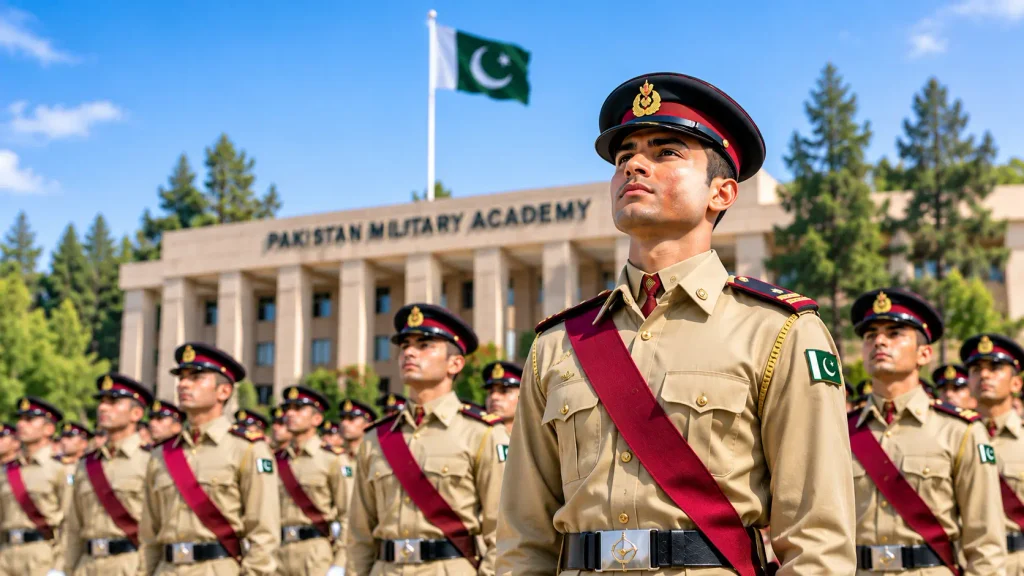
Candidates preparing for the Pakistan Military Academy entry test often search for PMA Long Course Past Papers to understand the question style, revise core subjects and practise under time pressure. This guide explains how to use past-paper-style MCQs, what to check before downloading a PDF, and how to build a realistic preparation routine.
Good preparation is not about memorising a collection of answers. It is about recognising question patterns, strengthening basic concepts and solving accurately within a limited time. Use the examples below as practice material, then confirm the latest test instructions through the official recruitment channel.
What do online PMA past-paper collections actually contain?
Many files shared online are compiled from preparation books, coaching notes or questions that candidates remember after an assessment. They can help you become familiar with common question styles, but they should not automatically be treated as original, verified or officially issued Pakistan Army papers.
Before relying on a file, check who prepared it, whether answers include explanations, when it was updated and whether the questions match the subjects mentioned in your current instructions. Be cautious of sellers promising a guaranteed or leaked paper. No private PDF can guarantee the questions that will appear in your test.
Areas to revise for the initial assessment
The exact assessment format and subject coverage can change. Follow the instructions on your registration slip and any current guidance from the Army Selection and Recruitment Centre. For general preparation, candidates commonly work on the following skill areas:
| Practice area | What to revise | Helpful approach |
|---|---|---|
| Verbal reasoning | Vocabulary, analogies, sentence completion and relationships between words | Read each option carefully and eliminate meanings that do not fit. |
| Non-verbal reasoning | Number or shape sequences, visual patterns, classification and logical relationships | Look for a changing rule, such as rotation, quantity or an increasing difference. |
| Academic knowledge | Basic English, mathematics, science and general knowledge appropriate to your educational background | Revise fundamentals instead of memorising isolated facts. |
Practising PMA Long Course previous papers can be useful when the source is clearly labelled and the answers are checked. Treat remembered questions as revision aids rather than a substitute for the current syllabus or official instructions.
Solved practice MCQs
Try each question before reading its answer. These original examples demonstrate the reasoning process and are suitable for a quick self-check.
Verbal reasoning
1. Choose the word closest in meaning to “accurate”.
A) Careless B) Precise C) Doubtful D) Weak
Correct answer: B) Precise. “Accurate” means correct or free from error; “precise” is the closest option.
2. Complete the sentence: “Each of the applicants _____ required to bring an original document.”
A) are B) were C) is D) have
Correct answer: C) is. “Each” is grammatically singular, so it takes “is” in this sentence.
3. Doctor is to hospital as teacher is to _____.
A) Court B) School C) Airport D) Market
Correct answer: B) School. A hospital is a common workplace for a doctor; a school is a common workplace for a teacher.
Non-verbal and logical reasoning
4. Find the next number: 3, 6, 11, 18, 27, _____.
A) 34 B) 36 C) 38 D) 40
Correct answer: C) 38. The differences are +3, +5, +7 and +9. The next difference is +11, giving 38.
5. Which number does not belong in the group: 8, 27, 64, 100, 125?
A) 27 B) 64 C) 100 D) 125
Correct answer: C) 100. The other numbers are cubes: 2³, 3³, 4³ and 5³. One hundred is not a perfect cube.
6. A sequence changes from triangle, square, pentagon, hexagon. Which shape should come next?
A) Circle B) Heptagon C) Octagon D) Rectangle
Correct answer: B) Heptagon. The number of sides increases by one: 3, 4, 5, 6, then 7.
Academic knowledge
7. In which year did Pakistan’s first Constitution come into force?
A) 1949 B) 1956 C) 1962 D) 1973
Correct answer: B) 1956. Pakistan’s first Constitution was promulgated on 23 March 1956, according to the Senate of Pakistan’s historical record.
8. What is the SI unit of force?
A) Joule B) Watt C) Newton D) Pascal
Correct answer: C) Newton. Force is measured in newtons, named after physicist Isaac Newton.
9. What is 15% of 200?
A) 20 B) 25 C) 30 D) 35
Correct answer: C) 30. Calculate 200 × 15 ÷ 100 = 30.
10. Which gas do green plants absorb from the atmosphere during photosynthesis?
A) Oxygen B) Nitrogen C) Carbon dioxide D) Hydrogen
Correct answer: C) Carbon dioxide. Plants use carbon dioxide and water, with light energy, to produce sugars and release oxygen.
For more targeted revision, use PMA Long Course verbal intelligence MCQs and PMA Long Course non verbal intelligence MCQs as separate timed drills. Then review PMA Long Course academic test MCQs by subject, especially the areas in which you make repeated mistakes.
How to choose and use a practice PDF
A useful PMA Long Course past papers PDF should be readable, organised and transparent about its source. Before downloading or printing a file, check these points:
- Clear source: The publisher or compiler should be identified. Avoid files described as “official” without proof.
- Answer quality: Prefer solved questions with short explanations, not just an answer letter.
- Readable layout: Check that diagrams, options and mathematical symbols are not cut off or blurred.
- Recent relevance: Compare its topics with the current instructions you have received.
- Safe download: Avoid suspicious pages that ask you to install unknown apps, provide unnecessary personal details or pay for guaranteed questions.
Use a PDF for offline revision, but do not spend the whole session reading it passively. Attempt questions first, mark uncertain answers and write down why you made each mistake. This turns a question collection into a useful learning record.
A practical seven-day revision routine
| Day | Main focus | Suggested task |
|---|---|---|
| 1 | Verbal ability | Revise vocabulary, analogies and sentence completion; attempt a timed set. |
| 2 | Reasoning | Practise number series, classifications and pattern questions. |
| 3 | Mathematics | Review percentages, ratios, averages and basic arithmetic. |
| 4 | English and science | Revise grammar and basic physics, chemistry and biology concepts. |
| 5 | General knowledge | Review Pakistan Studies, important national facts and current affairs. |
| 6 | Mixed practice | Complete a PMA Long Course practice test under a timer and note weak areas. |
| 7 | Revision | Reattempt incorrect questions and revise key concepts; avoid last-minute cramming. |
Adjust the routine to your available time and educational background. Short, consistent sessions are usually more productive than trying to finish a large question bank in one sitting. You can also use the ExamChamber subject-wise practice section for English, mathematics, science, general knowledge and intelligence revision.
Frequently asked questions
Are official PMA Long Course past papers available as free PDFs?
Do not assume that a file shared online is an official Army paper. Verify its source before using it, and treat candidate-recalled or coaching-centre compilations as unofficial practice material unless the Army itself confirms otherwise.
Do questions from older courses help with preparation?
Older collections can help you practise vocabulary, reasoning methods and academic basics. However, they may contain incorrect answers or outdated topics, so compare them with your current test instructions.
Are solved MCQs enough to prepare for the initial test?
No single question bank is enough on its own. Combine MCQ practice with concept revision, timed exercises and careful review of mistakes. Follow the official instructions for the current selection cycle.
Where should I confirm the latest registration and test instructions?
Use the official Pakistan Army recruitment portal and the instructions provided by your relevant Army Selection and Recruitment Centre. Requirements and schedules can change between courses.
Prepare with practice, not guesswork
Past-paper-style questions are most valuable when you use them to identify weak areas, improve speed and strengthen the concepts behind each answer. Choose transparent study material, practise in timed sessions and verify recruitment details through official channels. For a wider collection of exam resources, browse the ExamChamber Past Papers section and use the subject portal for focused revision.
Explore Subject-Wise MCQ PracticePreparation note: This guide is educational material. It is not an official Pakistan Army publication and does not guarantee selection or a particular test result.

Recent Comments