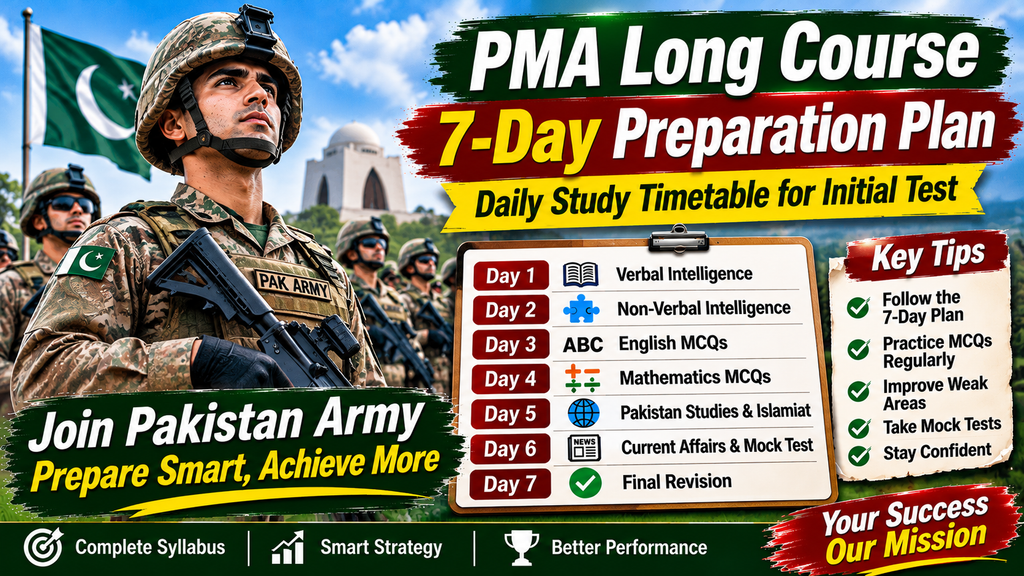
A focused PMA Long Course 7-Day Preparation Plan can help Pakistani candidates use the final week wisely by balancing intelligence practice, academic revision, timed tests and rest. The aim is not to learn every subject from zero; it is to strengthen familiar topics, improve accuracy and enter the test centre calm and organized.
This guide gives you a practical seven-day routine for the initial test. Adjust the hours to your college, university, job or family commitments, and use your own registration instructions as the final authority. For broader eligibility and selection guidance, read the ExamChamber PMA Long Course guide.
What to Prepare During the Week
Most candidates benefit from dividing study time between verbal reasoning, non-verbal reasoning and academic revision. Practice areas commonly used in preparation include word relationships, sequences, coding, classification, visual patterns, English, basic mathematics, Pakistan Studies, Islamiat and general knowledge.
The exact syllabus, format and sequence can change between intakes, so confirm the current requirements through the official Pakistan Army recruitment portal.
Important preparation tip: Keep a notebook for errors. For every wrong answer, write down whether the cause was a missing concept, a misread question, a calculation mistake or rushing. Reviewing this notebook is often more useful than repeatedly attempting questions without learning from mistakes.
Your Seven-Day Preparation Schedule
Day 1 — Check Your Current Level
Start with a short diagnostic session. Attempt a small timed set of verbal questions, a set of non-verbal questions and a mixed academic quiz. Do not worry about the score; use it to identify your strongest and weakest areas.
Spend the remaining study time revising the basics of your two weakest topics and organizing notes for the week.
Day 2 — Improve Verbal Reasoning
Focus on analogies, word relationships, number and letter series, coding and decoding, classification, directions and simple logical questions.
In your PMA verbal intelligence test practice, begin with untimed questions to understand the rule behind each answer. Then complete two or three short timed sets. Review every incorrect response and note the pattern you missed.
Day 3 — Practise Visual Reasoning
Work on figure sequences, pattern completion, shape matching, rotations, mirror images and odd-one-out exercises where they appear in your practice material.
For PMA non-verbal intelligence test practice, look carefully at direction, position, number of shapes and changes from one figure to the next. Avoid guessing quickly; build a repeatable method for checking each option.
Day 4 — Revise Academic Subjects
Use this day for PMA academic test preparation. Review English grammar, vocabulary and sentence structure, followed by basic mathematics such as fractions, percentages, ratios, averages and simple algebra.
Then revise key Pakistan Studies and Islamiat facts, along with general knowledge and recent national or international developments. Prioritize the subjects listed in your current recruitment instructions.
Day 5 — Combine Sections and Close Gaps
Attempt mixed practice instead of studying only one area. Complete a short reasoning set, then switch to academic questions.
Practise PMA Long Course MCQs from reliable study material and mark questions that take too long. Return to the error notebook and revise the three topics that are still causing the most mistakes.
Day 6 — Take a Realistic Mock Test
Complete one PMA Long Course mock test under quiet, timed conditions. Follow the timing and section instructions provided by your current test information; do not assume that an online practice paper has the same number of questions or time limit as the actual assessment.
After finishing, check your answers and spend at least as much time reviewing mistakes as you spent on the test.
Day 7 — Revise Lightly and Prepare for Test Day
Do a short review of your error notebook, important formulas, vocabulary and key facts. You may complete a small confidence-building question set, but avoid a long, exhausting mock test.
Prepare the documents and items specified in your roll number slip or official instructions, plan your travel to the selection centre and get a full night’s sleep.
A Practical Daily Routine
If you can study for about four focused hours, try this flexible routine:
| Time | Study Activity | Daily Goal |
|---|---|---|
| Morning | 60–75 minutes of verbal or non-verbal reasoning | Improve reasoning speed and accuracy |
| Afternoon | 90 minutes of academic revision | Strengthen one or two subjects |
| Evening | 60 minutes of timed MCQs and 30 minutes reviewing wrong answers | Build test confidence and identify mistakes |
| Before bed | 10–15 minutes of light recall | Revise important facts and rest |
If you attend classes or work, split these sessions into shorter blocks. Consistency and active review matter more than following the clock exactly.
How to Make the Final Week More Effective
Use a timer during practice, but do not sacrifice accuracy just to finish faster. Read each question carefully, eliminate clearly incorrect options and move on when a question is taking too long. Return to it only if the test instructions and remaining time allow.
Use textbooks and reliable notes for concepts, then use quizzes to check understanding. Avoid memorizing answer keys without learning why an option is correct. Do not depend on claims that a particular set of questions is guaranteed to appear.
Remember: The seven-day plan focuses on academic and intelligence preparation. Physical fitness, medical assessment, interview and later ISSB stages may also form part of the broader selection process, depending on the current entry instructions. Keep a balanced routine and do not begin intense last-minute exercise that could cause injury. For official information about later assessment, consult the Inter Services Selection Board website.
Frequently Asked Questions
Can I Prepare for the PMA Initial Test in Seven Days?
Seven days can help you organize revision and improve familiarity with question styles, especially if you already have a basic foundation. It is not a guaranteed route to passing, and candidates who are starting from zero may need a longer preparation period.
How Many Hours Should I Study Each Day?
Around four focused hours can be a useful starting point for this one-week plan. Increase or reduce the time according to your current level, responsibilities and ability to stay focused. Take short breaks to avoid fatigue.
Should I Practise Verbal and Non-Verbal Questions Every Day?
Include both regularly, but give extra time to the section where your diagnostic practice shows weaker performance. On mixed-practice days, attempt both sections so that you do not lose familiarity with either format.
Does This Timetable Guarantee Success?
No timetable or practice resource can guarantee selection. The plan is intended to make revision more organized; actual assessment requirements and selection decisions are set by the Pakistan Army.
Conclusion
A successful final week is built around focused practice, careful review and enough rest. Follow the daily schedule, strengthen weak areas, use timed quizzes sensibly and check your current recruitment instructions before test day.
Start with the first diagnostic session, track your progress honestly and keep your preparation steady.

Recent Comments