Planning a degree, postgraduate course, or professional registration in an English-speaking setting? The IELTS Academic Test measures the listening, reading, writing, and speaking skills needed for academic study. This guide explains who it suits, what happens in each section, how scores work, and how to prepare with purpose.
What Is IELTS Academic?
IELTS Academic is the version of IELTS designed for applicants entering undergraduate or postgraduate study and, in some cases, professional registration. It focuses on the kind of language used in lectures, textbooks, research, and formal discussion. Universities, regulators, and course providers set their own entry scores, so always check the requirement for your exact programme or profession.
The test assesses four skills: Listening, Reading, Writing, and Speaking. Listening and Speaking are shared with General Training, while Reading and Writing use academic materials and tasks. That difference matters if your aim is higher education rather than migration or general workplace evidence.
Who Should Take IELTS Academic?
This route is normally appropriate for students applying to colleges or universities in the UK, Europe, North America, Australia, New Zealand, and other international destinations. It can also be requested by professional bodies for fields such as healthcare, teaching, engineering, or accounting.
- Applicants to bachelor’s, master’s, doctoral, foundation, or pathway programmes.
- Scholarship candidates whose institution specifies an academic English score.
- Professionals who must demonstrate English for registration or study-related licensing.
- Students who want an academic assessment before beginning an English-medium course.
IELTS Academic Test Format
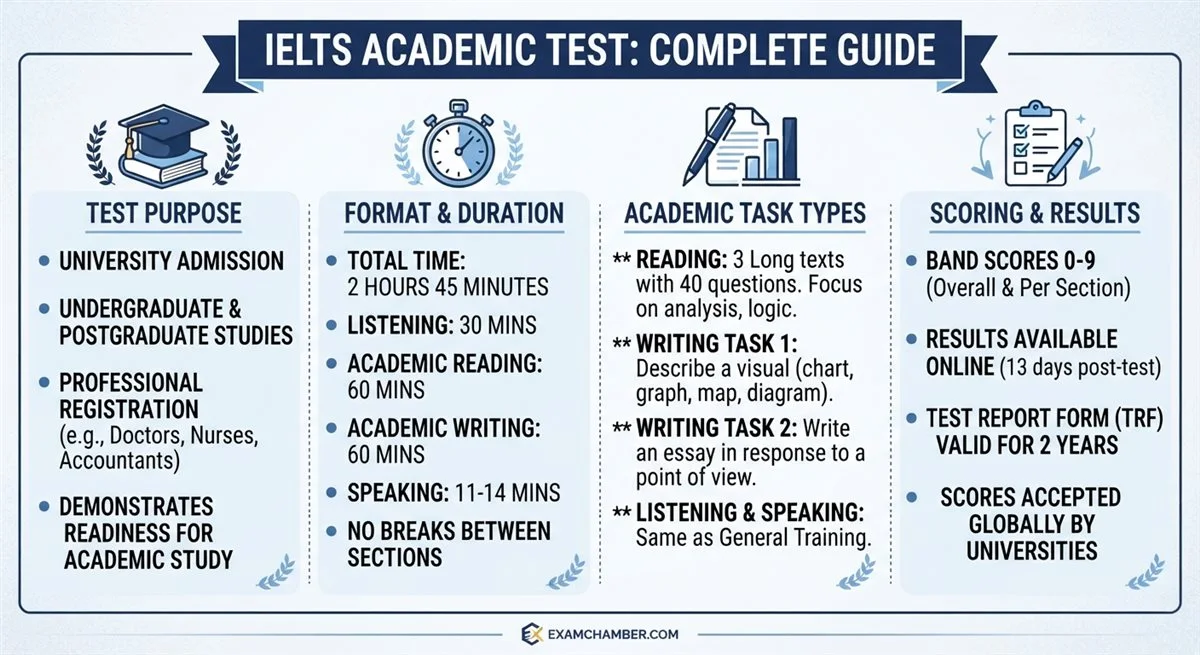
The IELTS Academic exam structure has four sections. The Listening, Reading, and Writing papers are normally scheduled together without breaks; Speaking may be arranged on the same day or separately, depending on the test centre. Official guidance describes the total test time as about 2 hours and 45 minutes.
| Section | Time | What to expect |
|---|---|---|
| Listening | About 30 minutes | Four recordings and 40 questions, using a range of everyday and academic contexts. |
| Reading | 60 minutes | Three long academic texts and 40 questions. |
| Writing | 60 minutes | Task 1 is a visual-information report; Task 2 is an essay response. |
| Speaking | 11–14 minutes | A three-part live interview with an examiner. |
Timing and delivery arrangements can vary slightly by test centre and test mode. Use the British Council’s official format guide when checking the current arrangement for your booking.
IELTS Academic Sections
Listening and Reading
Listening contains four recordings and 40 questions. You hear a range of international accents, so practice should include more than one familiar accent. Read the instructions carefully: spelling, word limits, singular/plural forms, and numbers can affect an otherwise correct answer.
The IELTS Academic Reading test presents three long texts drawn from sources such as books, journals, magazines, and newspapers. Expect question types such as matching headings, multiple choice, summary completion, and True/False/Not Given. Train yourself to skim for the main idea, scan for a detail, and return to the text rather than relying on memory.
Writing and Speaking
In the IELTS Academic Writing test, Task 1 asks you to describe a chart, table, graph, map, or process in at least 150 words. Task 2 asks for an essay of at least 250 words. Task 2 carries more weight, so reserve enough time to plan, develop, and check it.
Speaking has three parts: an introduction and interview, a short individual talk based on a cue card, and a wider discussion. Aim to answer directly, develop your ideas with a reason or example, and speak naturally. It is not a memorised speech test; clear communication and flexibility matter more than impressive-sounding phrases.
IELTS Academic Scoring System
Each section receives a band from 0 to 9, in whole and half bands. Your overall result is the average of the four section scores, rounded according to IELTS rules. There is no universal pass mark: an institution may require an overall score, a minimum in each section, or both.
An IELTS Academic band score is a snapshot of English ability at the time of testing, not a permanent qualification. For the exact rounding approach, score conversions, and assessment criteria, review the official IELTS scoring explanation.
IELTS Academic Band Scores
| Band | Official skill label | Plain-language meaning |
|---|---|---|
| 9 | Expert user | Very complete, accurate, fluent command of English. |
| 8 | Very good user | Strong command with occasional unsystematic inaccuracies. |
| 7 | Good user | Effective command, including complex language, with some inaccuracies. |
| 6 | Competent user | Generally effective communication despite some mistakes or misunderstandings. |
| 5 | Modest user | Partial command that handles overall meaning in many situations. |
Do not assume that one score is suitable everywhere. A competitive course may ask for a higher Writing result than its overall threshold, while another course may have different conditions. Read the offer or admissions page before setting your target.
How to Prepare for IELTS Academic
Effective IELTS Academic preparation starts with a diagnostic test. Find the section that currently costs you the most marks, then create a routine that alternates skill practice with timed review. A realistic plan is more useful than trying to study all four skills intensively every day.
- Learn the task rules. Know the question types, word limits, answer-transfer method, and timing before practising for speed.
- Build accuracy first. Keep an error log for vocabulary, grammar, spelling, and question types you miss; revisit it weekly.
- Use timed practice. Gradually work toward full-section conditions. After each attempt, identify why an answer was wrong rather than only checking the score.
- Get focused feedback. For Writing and Speaking, ask a qualified teacher or experienced reviewer to comment on task response, organisation, vocabulary, grammar, fluency, and pronunciation.
- Rehearse test day. Complete at least one full practice run, prepare your identification documents, and confirm the rules of your chosen centre.
For structured, mobile-friendly practice, use ExamChamber’s free online IELTS practice tests to build timing and familiarity. You can also strengthen the grammar and vocabulary behind every module with the site’s English practice resources.
Frequently Asked Questions
Is IELTS Academic accepted for study abroad?
It is widely used for higher-education applications, but you should confirm the exact score and accepted delivery mode with your university or programme.
Are Listening and Speaking different from General Training?
No. The main differences between Academic and General Training are in Reading and Writing.
How long are results valid?
IELTS recommends that results are treated as valid for two years. Individual institutions may apply their own acceptance policies, so check directly with the organisation receiving your score.
Final Takeaway
Choose the academic route when your destination needs evidence of English for university-level study or relevant professional registration. Once you know your target score, work backward: master the format, practise under time limits, seek useful feedback, and verify every requirement with the organisation that will receive your result.
Ready to practise with a plan?
Start with a timed skill check, record the errors that repeat, and make your next practice session more targeted than the last.
Explore IELTS Practice at ExamChamber
Recent Comments