The IELTS Exam Sections are designed to measure how effectively you understand and communicate in English across different situations. Every full IELTS test assesses Listening, Reading, Writing and Speaking. Each part uses different tasks, so knowing the format helps you prepare with confidence and manage your time.
Whether you are applying to a university, exploring professional registration or meeting an English-language requirement, understanding the four skills is a practical first step. The overview below explains what happens in each section and how Academic and General Training candidates are assessed.
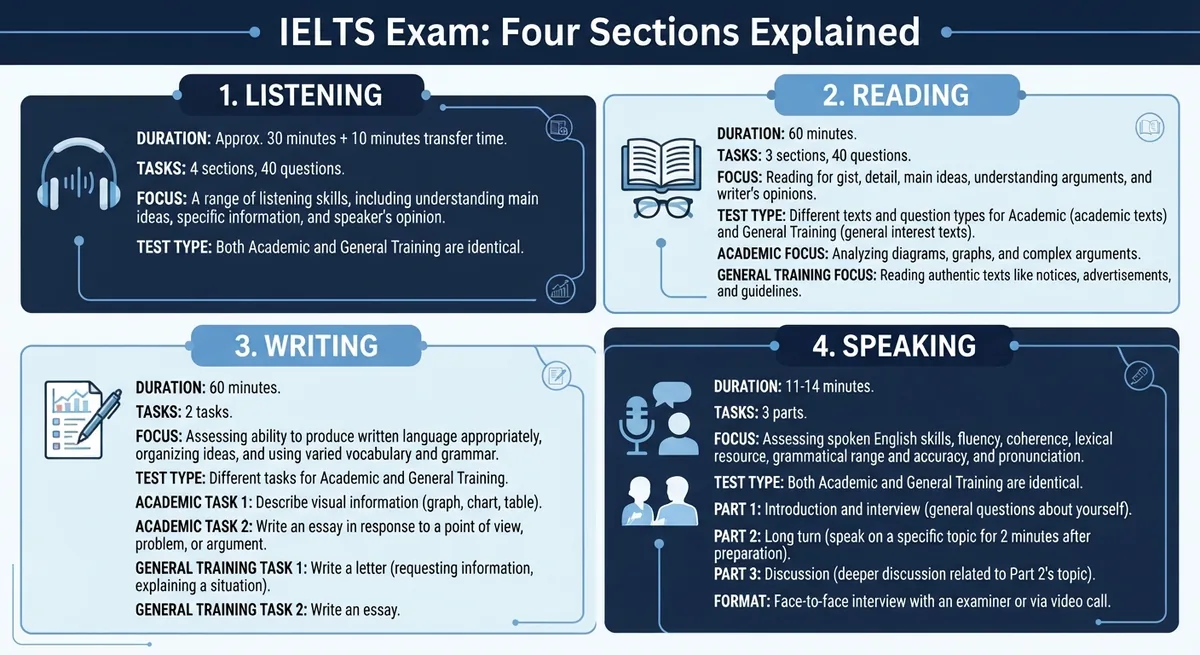
IELTS Test Components at a Glance
The full test takes approximately 2 hours and 45 minutes. Listening, Reading and Writing are usually arranged as a continuous session, while Speaking may be scheduled on the same day or separately according to the test centre’s arrangements.
| Section | Typical duration | Format |
|---|---|---|
| Listening | About 30 minutes | 4 parts, 40 questions |
| Reading | 60 minutes | 3 sections, 40 questions |
| Writing | 60 minutes | 2 tasks |
| Speaking | 11–14 minutes | 3 parts |
1. IELTS Listening Section
The IELTS Listening section tests whether you can understand spoken English in everyday, social, educational and training situations. You listen to four recordings and answer a total of 40 questions. The recordings are played once, and a range of accents may be used.
What happens in the four parts?
- Part 1: A conversation between two people in an everyday situation, such as arranging a service or making a booking.
- Part 2: One person speaks about an everyday or social topic, such as describing facilities or giving information about a place.
- Part 3: A conversation involving two or more speakers in an educational or training context, such as students discussing an assignment.
- Part 4: One speaker gives a longer talk on an academic or educational subject.
Common question types
You may answer multiple-choice questions, match information, label a map or diagram, complete a form or set of notes, fill gaps in sentences, or provide short answers. Read the word limit in each instruction carefully. An answer that exceeds the stated limit may not receive a mark even when it contains the correct information.
How to prepare for Listening
Practise listening for names, numbers, dates, locations and changes in a speaker’s plans. Before each recording begins, use the available time to preview the questions and identify the information you need to hear. After practice, review spelling and singular or plural forms as well as missed answers.
2. IELTS Reading Section
The IELTS Reading section assesses how accurately and efficiently you understand written English. It lasts 60 minutes and contains 40 questions across three sections. You need to identify main ideas, locate details, follow arguments and understand the writer’s views.
Academic and General Training Reading
The IELTS Academic Reading section uses longer texts drawn from sources such as books, journals, magazines and newspapers. The topics are intended for a broad, educated audience, and the texts may include descriptive, factual or argumentative writing.
General Training Reading uses a different progression. Early texts commonly reflect everyday situations such as notices, advertisements and practical information. Another section focuses on workplace-related material, while the final section contains a longer text on a general-interest topic.
Common Reading question types
- Multiple choice and matching headings.
- Matching information, features or sentence endings.
- True / False / Not Given for factual statements.
- Yes / No / Not Given for the writer’s views or claims.
- Sentence, summary, note, table or flow-chart completion.
- Diagram labelling and short-answer questions.
For True / False / Not Given, use only the information in the passage. “False” means the text contradicts the statement, while “Not Given” means the text does not provide enough information to decide. Do not use your personal knowledge to fill gaps.
How to manage Reading time
Work steadily and avoid spending too long on one difficult question. Skim each passage to understand its structure, then scan for names, dates, keywords and paraphrased ideas. The question order often provides clues, but matching and summary tasks may require you to search more broadly.
3. IELTS Writing Section
The IELTS Writing section lasts 60 minutes and contains two tasks. Both must be completed in full sentences and connected writing, not as notes or bullet points. The task types in Academic and General Training are different in Task 1, but Task 2 is an essay in both versions.
Academic Writing
Task 1: You describe visual information, which may be a graph, chart, table, map, plan or process diagram. You should write at least 150 words and focus on the key features, comparisons or stages rather than describing every minor detail.
Task 2: You write an essay in response to a point of view, issue, argument or problem. Your answer must be at least 250 words and should develop a clear position with relevant reasons and examples.
General Training Writing
Task 1: You write a letter in response to a situation. Depending on the prompt, the letter may be formal, semi-formal or informal. You need to address the points in the task and use an appropriate tone.
Task 2: You write an essay of at least 250 words, discussing a point of view, argument or problem. The subject matter and assessment approach are designed for the General Training test, but the task still requires a relevant, well-organised response.
Timing and assessment
A useful time plan is about 20 minutes for Task 1 and 40 minutes for Task 2. Task 2 contributes twice as much as Task 1 to the Writing score, so protect enough time to plan, develop and check your essay. Examiners assess task achievement or response, coherence and cohesion, lexical resource, and grammatical range and accuracy.
4. IELTS Speaking Section
The IELTS Speaking section is a recorded interview with a trained examiner. It lasts approximately 11–14 minutes and is divided into three parts. It assesses how clearly and effectively you express ideas, rather than whether you can memorise prepared speeches.
Part 1: Introduction and interview
This part usually lasts 4–5 minutes. The examiner asks questions about familiar subjects such as your home, work, studies, interests or daily routine. Give direct answers and add a relevant detail or short explanation when appropriate.
Part 2: Individual long turn
You receive a task card about a particular topic and have one minute to prepare. You can make brief notes, then speak for up to two minutes. Organise your response so that it has a clear beginning, connected details and a natural ending.
Part 3: Two-way discussion
This part lasts about 4–5 minutes and explores ideas connected to the Part 2 topic in greater depth. Questions may ask you to compare, explain causes, discuss changes or consider different viewpoints. Support your opinions with reasons or examples instead of giving only one-word answers.
Speaking is assessed using four criteria: fluency and coherence, lexical resource, grammatical range and accuracy, and pronunciation. A clear, natural response is more useful than forcing complicated vocabulary into every sentence.
How Academic and General Training Differ
There are two main IELTS modules: Academic and General Training. The Listening and Speaking tests are the same in both. The Reading and Writing sections use different texts and tasks to match the purpose of each test.
| Section | Academic | General Training |
|---|---|---|
| Listening | Same format and question structure | Same format and question structure |
| Reading | Academic-style texts from general and educational sources | Everyday, workplace and general-interest texts |
| Writing Task 1 | Describe visual information | Write a letter for a stated purpose |
| Writing Task 2 | Essay | Essay |
| Speaking | Same three-part interview | Same three-part interview |
Choose the module requested by the university, employer, professional body or immigration authority that will receive your result. Do not assume that one version can replace the other. You can compare the official IELTS Academic format and IELTS General Training format before booking.
How the Four Sections Are Scored
Listening and Reading are marked using correct answers, with each correct response earning one mark before the raw score is converted to an IELTS band score. Writing and Speaking are assessed by trained examiners against published performance criteria. Each skill receives its own band score, and the four skills are used to calculate the overall band.
There is no single passing score for every candidate. Universities, employers and other organisations set their own overall and, sometimes, minimum skill-score requirements. Always check the requirement for your specific application.
How to Prepare for Each Section
A balanced study plan gives time to all four skills instead of focusing only on the section you enjoy most. Use timed practice to become familiar with the pace of the test and review every mistake to understand why an answer was wrong.
- Listening: practise with different English accents and a range of recordings. Review missed details and spelling.
- Reading: read varied texts, practise skimming and scanning, and learn the differences between question instructions.
- Writing: practise both tasks for your test type. Plan before writing and leave time to check whether you answered every part of the prompt.
- Speaking: speak aloud regularly, record short answers and practise explaining opinions with examples. Aim for clear, connected communication.
Frequently Asked Questions
What are the four sections of the IELTS exam?
The four sections are Listening, Reading, Writing and Speaking. Together, they assess a candidate’s ability to understand and communicate in English.
How many questions are in IELTS Listening and Reading?
Listening contains 40 questions across four parts. Reading contains 40 questions across three sections.
Are the four sections identical in Academic and General Training?
No. Listening and Speaking are the same in both modules. Reading and Writing differ in text types and task formats.
How long does the IELTS test take?
The full test takes approximately 2 hours and 45 minutes. Listening is about 30 minutes, Reading and Writing are 60 minutes each, and Speaking lasts 11–14 minutes. Exact instructions depend on the test arrangement.
Which IELTS section is the most difficult?
There is no section that is hardest for every candidate. The level of difficulty depends on your English skills, familiarity with the task types and time management.
Can I take a break between the test sections?
Listening, Reading and Writing are generally scheduled as one continuous session. Follow your test centre’s instructions about breaks and the timing of your Speaking appointment.
Conclusion
Understanding the Listening, Reading, Writing and Speaking sections makes IELTS preparation more focused. Learn the task formats, practise within the time limits and review your performance in every skill. Once you know what each section expects, you can build a practical study routine and approach the test with greater confidence.

Recent Comments