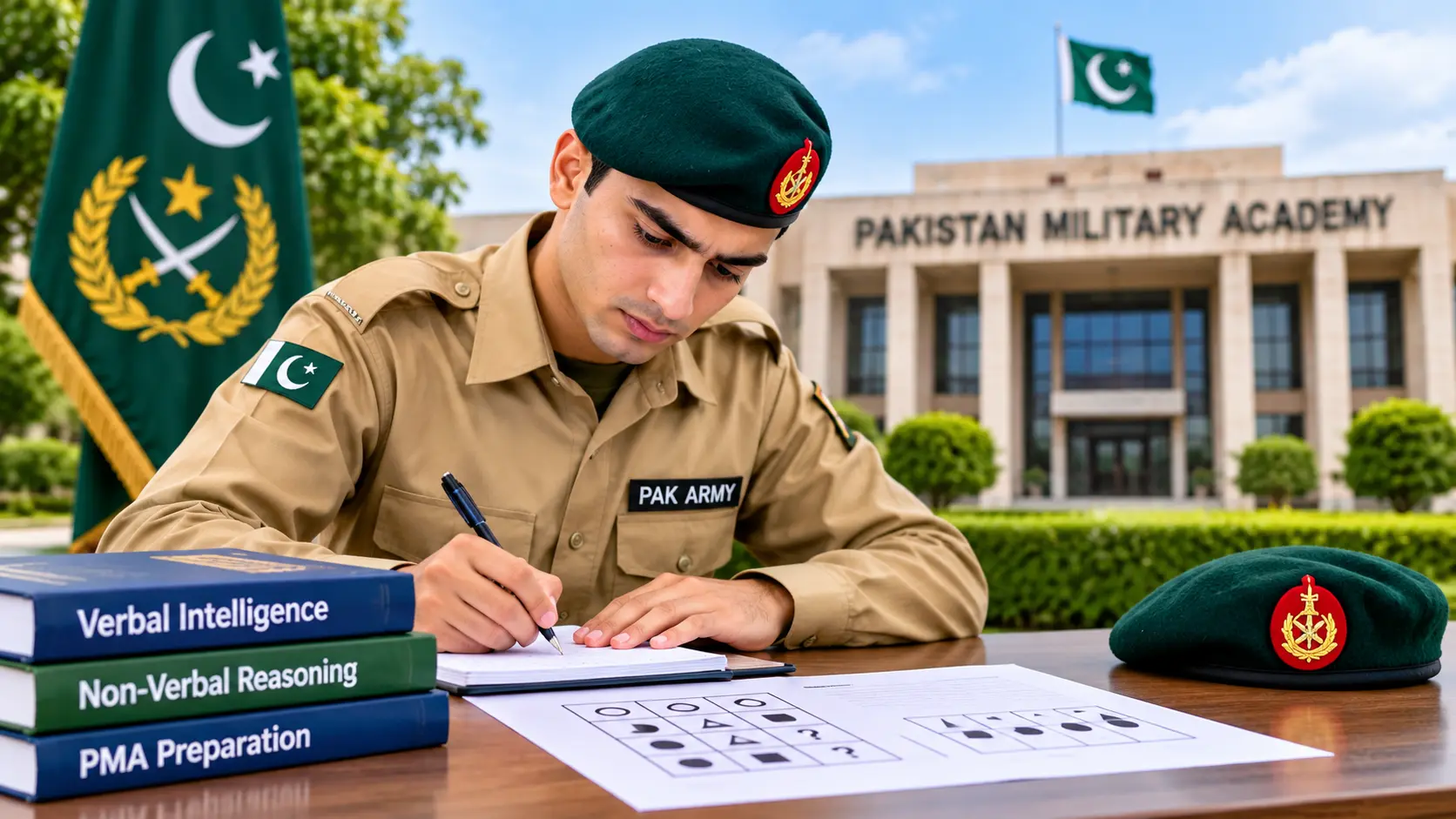
The PMA Long Course intelligence test is an important part of the Pakistan Army’s initial selection process. It assesses how quickly you understand information, recognise relationships, solve problems and identify patterns. With regular practice and a calm approach, you can improve your accuracy and confidence before reporting to your Army Selection and Recruitment Centre (AS&RC).
What Does the Intelligence Test Assess?
The assessment is generally discussed in two parts: verbal reasoning and non-verbal reasoning. The Pakistan Army intelligence test is designed to check aptitude rather than how much information you have memorised from a textbook. Questions may ask you to work with words, numbers, letters, shapes or visual sequences.
The exact format, number of questions and time allowed can differ between entry instructions and test arrangements. Treat online patterns as practice guidance, not as a guaranteed paper. Always follow the instructions on your registration slip and those given by the staff at your AS&RC.
1. Verbal Intelligence Test Preparation
A PMA verbal intelligence test usually involves reasoning with written information. You may need to identify a relationship, continue a sequence, select an odd item or find a rule connecting letters and numbers. Read each question carefully, but avoid spending too long on one difficult item.
Common verbal question types
- Number series: Find the missing number by checking addition, subtraction, multiplication or changing differences.
- Alphabet series: Observe letter positions and identify the next letter or missing group.
- Analogies: Understand the relationship between two words, then select another pair with the same relationship.
- Odd one out: Find the word, number or item that does not follow the common rule.
- Coding and decoding: Identify a simple letter or number substitution and apply it consistently.
- Basic logical reasoning: Solve short questions involving order, direction, age or relationships.
Practice example – Number series
2, 6, 12, 20, 30, ?
Answer: 42. The differences are +4, +6, +8 and +10. The next difference is +12, so 30 + 12 = 42.
Practice example – Analogy
Book is to Read as Food is to _____.
Answer: Eat. A book is read, while food is eaten. Focus on the relationship, not just on words that look similar.
2. Non-Verbal Intelligence Test Preparation
A PMA non verbal intelligence test focuses on visual reasoning. Instead of relying mainly on written words, you study shapes, diagrams and figures to discover a rule. Some candidates find this section challenging because it requires careful observation under time pressure.
Common practice areas include figure sequences, missing shapes, rotations, mirror images, embedded figures, shape grouping and pattern completion. These are useful preparation categories, but they should not be treated as a confirmed list of questions for every intake.
How to solve figure-based questions
- Check the movement: See whether a shape moves clockwise, anticlockwise, left, right, up or down.
- Count the elements: Compare the number of lines, dots, corners or shapes in each figure.
- Observe changes: Look for rotation, reflection, shading, size or direction changes.
- Find the repeating rule: Compare all figures before selecting an answer; do not guess from only the first two.
- Eliminate mismatches: Remove options that break the pattern, then compare the remaining choices.
Preparation tip: Practise non verbal intelligence test questions with clear diagrams. On a phone, enlarge the image when studying, but practise some timed sets on a computer as well so you become comfortable viewing questions on a screen.
Important Areas to Cover
Use the following outline as a practical PMA intelligence test syllabus for revision. It groups the main skills to practise without claiming that every topic appears in every test.
| Section | Practice areas | Skill to develop |
|---|---|---|
| Verbal reasoning | Series, analogies, coding, odd one out, directions and basic logic | Recognising rules and relationships quickly |
| Non-verbal reasoning | Figure series, rotations, reflections, missing figures and patterns | Visual observation and spatial reasoning |
| Speed and accuracy | Mixed practice sets and timed revision | Managing time without careless errors |
Remember that the intelligence portion is not the whole initial assessment. Candidates should also revise the academic subjects mentioned in the current course instructions. For English practice, use the English preparation section on ExamChamber, alongside the relevant study material for their entry.
A Simple 14-Day Preparation Plan
A short, consistent routine is more useful than trying to memorise hundreds of answers in one sitting. Adjust the plan around your school, college or work schedule.
| Days | Main focus | What to do |
|---|---|---|
| 1–2 | Starting assessment | Attempt a mixed practice set and note your weaker areas. |
| 3–5 | Verbal reasoning | Practise series, analogies, coding and logical questions; review every mistake. |
| 6–8 | Non-verbal reasoning | Work on figure patterns, rotation, reflection and missing shapes. |
| 9–11 | Mixed practice | Switch between both sections and practise making decisions efficiently. |
| 12–13 | Timed revision | Complete mock sets under a time limit you select and analyse errors afterwards. |
| 14 | Light review | Revise common rules, prepare your documents and get proper rest. |
For additional drills, open the intelligence and IQ test practice section. Begin with basic questions, then move to mixed sets as your accuracy improves.
Common Preparation Mistakes to Avoid
- Memorising answer keys: Learn the reasoning rule so you can solve an unfamiliar question.
- Ignoring explanations: After a wrong answer, identify exactly where your logic went off track.
- Practising only one section: Divide your preparation between verbal and non-verbal exercises.
- Rushing every question: Build speed gradually while keeping accuracy under control.
- Trusting unofficial test claims: Avoid relying on guaranteed-question lists or fixed timings shared without an official source.
What to Do on Test Day
Reach your assigned centre at the reporting time and carry the documents specified in your instructions. Listen to the invigilator before starting, read the on-screen directions and make sure you understand how to select or submit an answer.
Stay composed if a question looks unfamiliar. Solve the items you understand, manage your time according to the instructions on screen and avoid changing an answer without a clear reason. The goal is to demonstrate your own reasoning ability, not to reproduce a memorised paper.
Check official instructions: Registration details, eligibility, test arrangements and required documents can change by entry. Confirm the latest information through the official Join Pakistan Army portal or your nearest Army Selection and Recruitment Centre.
Frequently Asked Questions
Is the intelligence test the same as the ISSB test?
No. The initial intelligence assessment at the recruitment stage is separate from the later ISSB selection process. Clearing an initial test does not by itself guarantee ISSB recommendation or final selection.
Are the same questions repeated in every PMA entry?
You should not expect an identical paper in every entry. Practise question types and reasoning methods rather than depending on recalled questions or claims of a guaranteed repeated set.
How should I divide my preparation time?
Start by identifying your weaker section. Give extra practice to that area while continuing mixed verbal and non-verbal revision. In the final days, focus on timed practice, reviewing mistakes and getting enough rest.
Can I prepare without joining an academy?
You can build a useful preparation routine with reliable practice material, timed exercises and careful review. Make sure any advice about the official test process is checked against current Army instructions.
Final Advice
Strong preparation comes from understanding patterns, practising consistently and learning from mistakes. Work on both verbal and non-verbal reasoning, improve your speed gradually and keep your academic subjects in your wider preparation plan. Most importantly, use official recruitment instructions for final decisions about your test and selection process.

Recent Comments