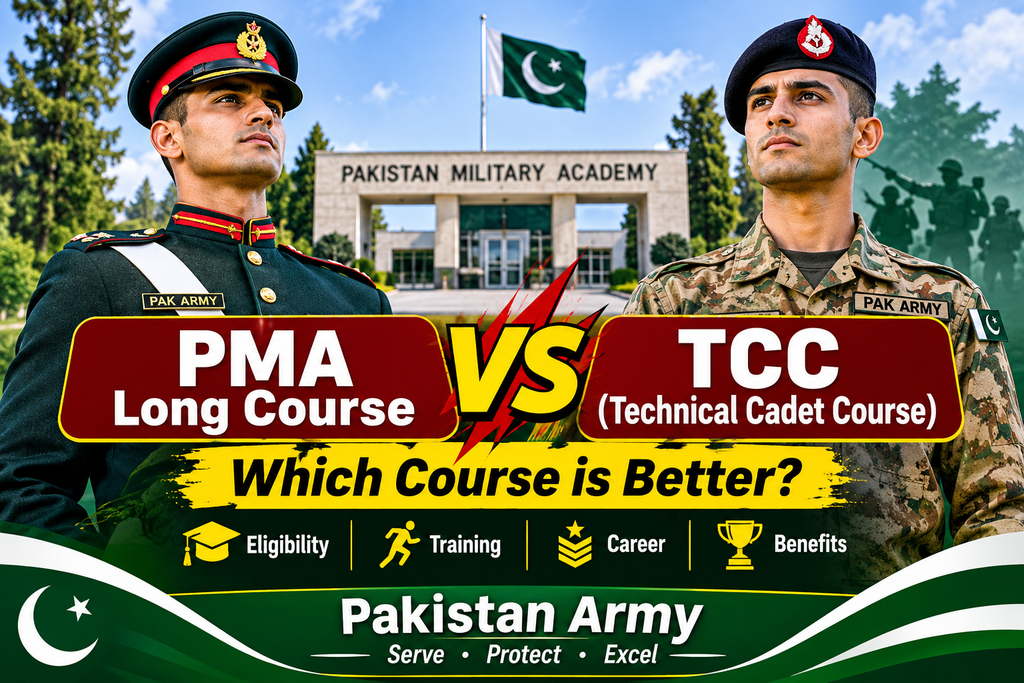
PMA Long Course vs TCC is an important comparison for Pakistani students who want to become commissioned officers in the Pakistan Army. Both pathways offer opportunities to serve the country, develop leadership skills and build a military career, but their educational requirements, training methods and professional specialisations are different.
The main difference is that the PMA Long Course prepares candidates for a broader military officer career, while the Technical Cadet Course (TCC) combines engineering education with military training. Understanding these differences can help you choose the entry route that matches your academic background, interests and long-term goals.
What Are PMA Long Course and Technical Cadet Course?
PMA Long Course
The Pakistan Military Academy Long Course is a regular commissioning route for eligible candidates who want to become officers in the Pakistan Army. Selected candidates receive military education and physical, tactical and leadership training at PMA Kakul in Abbottabad.
After successfully completing the required training, cadets are commissioned as Second Lieutenants. This route is suitable for candidates interested in general military leadership, operational responsibilities and service in different arms and services of the Army.
Technical Cadet Course (TCC)
The Technical Cadet Course is designed for students who want to combine an engineering education with a commissioned officer career. Selected candidates study in designated NUST military colleges and complete the required engineering degree before receiving military training at PMA Kakul.
After successfully completing the academic and military requirements, TCC cadets are commissioned as Captains in the relevant technical branch. Engineering disciplines and available seats depend on the particular recruitment advertisement.
Major Differences Between the Two Courses
Although both routes lead to commissioned service, they are designed for different career interests. The following table highlights their major differences.
| Comparison | PMA Long Course | Technical Cadet Course |
|---|---|---|
| Primary purpose | General military officer training | Engineering and technical officer development |
| Educational entry | Intermediate or other accepted qualifications | FSc Pre-Engineering or accepted computer science combination |
| Academic focus | Military studies and leadership development | Engineering degree and technical education |
| Military training | Approximately 2 years at PMA Kakul | Approximately 1 year at PMA after the engineering degree |
| Engineering education | Not the main purpose of this entry route | Approximately 4 years of engineering education |
| Commissioning rank | Second Lieutenant | Captain |
| Main career direction | Military leadership and operational duties | Engineering and technical military duties |
| Best suited for | Candidates interested in general military service | Students interested in science, mathematics and engineering |
Eligibility Criteria and Educational Requirements
Educational qualifications are one of the most important differences between these entry schemes. Candidates should review their academic subjects, marks, age and physical standards before applying.
PMA Long Course Eligibility
The PMA Long Course accepts several educational backgrounds according to the rules of the relevant intake. Common applicant categories include:
- FA and FSc candidates with the required marks.
- Eligible candidates holding equivalent qualifications such as A-Levels.
- Graduates applying under the relevant degree-holder category.
- Serving Army personnel who meet the applicable eligibility conditions.
A commonly published general benchmark for Intermediate applicants is 60% marks. However, graduate categories, regional concessions, age limits and other requirements may be different. Candidates must check the current advertisement rather than assuming that one percentage applies to everyone.
Technical Cadet Course Eligibility
Technical Cadet Course eligibility is more specific because candidates must have the required science and mathematics background for engineering education.
Recent recruitment information commonly specifies:
- FSc Pre-Engineering or an accepted Computer Science combination.
- Approximately 65% marks in FSc or the accepted equivalent qualification.
- Required Physics and Mathematics subjects, together with the relevant third subject.
- Additional Matriculation and subject requirements mentioned in the advertisement.
- Compliance with the prescribed age, height, weight and medical standards.
Training Duration and Academic Life
Training is another major difference between these pathways. One focuses primarily on military development, while the other includes a complete engineering degree.
PMA Long Course Training
The standard PMA Long Course military training period is approximately two years, divided into four terms of six months. Cadets develop the discipline and professional skills required for military service.
Training generally includes:
- Physical fitness and endurance development.
- Military drill and discipline.
- Weapon handling and field activities.
- Leadership, teamwork and tactical instruction.
- Military subjects and professional development.
TCC Training Duration
The Technical Cadet Course follows a longer combined academic and military pathway. Cadets generally complete a four-year engineering degree at their designated institution, followed by approximately one year of military training at PMA Kakul.
Depending on the allocation and recruitment intake, the engineering programme may cover disciplines such as Civil, Electrical, Mechanical, Software, Computer, Mechatronics and Information Security.
The available disciplines are not necessarily identical in every intake. Candidates should check the current course advertisement and the official NUST programme information.
Career Opportunities After Commissioning
Both routes provide a pathway to regular commissioned service, but professional responsibilities can differ considerably.
Career After PMA Long Course
PMA Long Course officers may serve in different arms, services and appointments according to Army requirements, performance, aptitude and allocation. Their work can involve leadership, operational planning, administration, training and command responsibilities as their careers develop.
Career After TCC
TCC officers are assigned to technical organisations and branches according to their engineering qualifications and service requirements. Their professional responsibilities can involve engineering projects, equipment, communications, technical systems, maintenance and other specialised military functions.
Both pathways offer opportunities for professional growth and further training. However, the nature of daily responsibilities depends on the officer’s branch, unit, appointment and career progression.
Salary, Rank and Financial Benefits
The PMA vs TCC Salary comparison requires an understanding of commissioning rank. PMA Long Course cadets are commissioned as Second Lieutenants, while successful TCC cadets are commissioned as Captains after completing their engineering and military training.
Because the commissioning ranks are different, their initial pay entitlements may also differ. However, it is not accurate to quote one fixed salary for every officer. Actual compensation depends on applicable military pay rules, rank, service, allowances, appointment and posting.
Pakistan Army TCC Benefits
The Technical Cadet Course offers an integrated academic and professional pathway. Selected candidates receive engineering education through designated military colleges as part of the Army’s course structure. The applicable financial arrangements must be checked in the recruitment advertisement.
Depending on service regulations and eligibility, commissioned officers may also receive:
- Military pay and applicable allowances.
- Medical facilities under service rules.
- Accommodation or relevant housing benefits.
- Professional and technical development opportunities.
- Leave and other service entitlements.
- Retirement and pension-related benefits under applicable policies.
Which Course Should You Choose?
The right choice depends on your interests, academic background and preferred professional direction.
Choose the PMA Long Course if you:
- Want to pursue a general military officer career.
- Are interested in leadership, field responsibilities and operational service.
- Meet the educational and physical requirements of the Long Course.
- Prefer the shorter military-training route instead of an engineering-degree pathway.
Consider TCC if you:
- Have a strong background in science and mathematics.
- Want to study engineering while pursuing a military career.
- Are interested in technical branches of the Pakistan Army.
- Meet the specific educational requirements of the advertised intake.
Selection Process and Test Preparation
Both entry routes involve a competitive selection process. Depending on the particular intake, candidates may undergo initial intelligence and academic assessments, physical tests, preliminary medical examinations, interviews and ISSB assessment before final selection.
TCC candidates should pay particular attention to the relevant science and mathematics subjects, whereas PMA Long Course candidates should prepare for the applicable intelligence and academic assessment.
You can improve your preparation through these ExamChamber resources:
- PMA Long Course complete preparation and eligibility guide.
- PMA Long Course academic test subjects and preparation guide.
Prepare for your Pakistan Army selection test with ExamChamber.
Practise academic subjects, improve your test knowledge and develop a consistent preparation routine.
Explore PMA PreparationFor current eligibility rules and registration details, visit the official Join Pakistan Army recruitment portal. Candidates interested in technical education can also review the NUST engineering programmes and institutions.
Frequently Asked Questions
1. What is the main difference between PMA Long Course and TCC?
The Long Course is a general military officer-entry pathway, whereas TCC combines engineering education with military training for technical officer appointments.
2. Which course takes longer to complete?
The Long Course generally involves two years of military training. TCC typically involves four years of engineering education followed by one year of military training.
3. What rank do TCC cadets receive after training?
Successful TCC cadets are generally commissioned as Captains after completing the prescribed engineering degree and military training.
4. Can an ICS student apply for TCC?
Some TCC intakes accept specified Computer Science combinations for particular technical disciplines. Eligibility depends on the subjects studied and the latest recruitment advertisement.
5. Is PMA Long Course better than TCC?
Neither course is universally better. The Long Course is suitable for candidates interested in general military leadership, while TCC is more suitable for those who want an engineering-focused Army career.
6. Are PMA Long Course and TCC benefits the same?
Both lead to commissioned military service, so many service benefits are governed by common Army regulations. However, pay and entitlements can vary according to rank, appointment and applicable policies.
Conclusion
Both the PMA Long Course and Technical Cadet Course provide valuable opportunities to serve as commissioned officers in the Pakistan Army. The Long Course offers a broader military leadership pathway, while TCC combines engineering education with technical military service.
Before making a decision, compare your Intermediate subjects, marks, age and career interests with the official eligibility requirements. A well-informed choice can help you prepare more effectively and select the pathway that suits your future ambitions.

Recent Comments