The IELTS Band Score shows how effectively a test taker can use English in Listening, Reading, Writing and Speaking. Rather than giving a simple pass-or-fail result, IELTS reports each skill on a scale from 0 to 9 and provides an overall score based on all four components.
What Is the IELTS Band Score System?
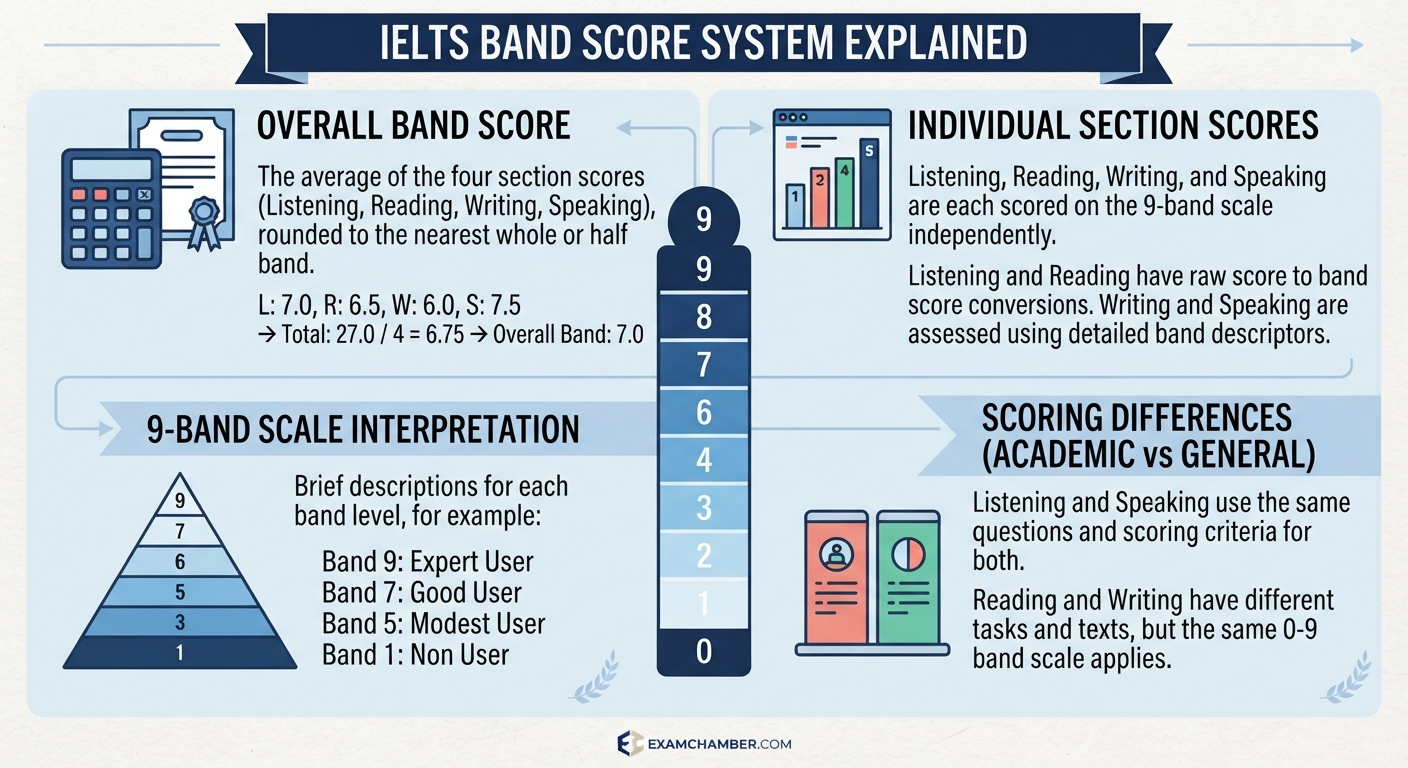
IELTS uses a nine-band framework to describe different levels of English language ability. A result may be reported as a whole band, such as 6.0 or 7.0, or a half band, such as 6.5 or 7.5. The same scale is used for IELTS Academic and IELTS General Training.
Your Test Report Form normally shows five results: one score for Listening, one for Reading, one for Writing, one for Speaking, and an overall band score. The individual results help universities, employers, professional organisations and other receiving bodies understand your strengths across the four skills.
Understanding the Nine Band Levels
Each band has a proficiency description called a band descriptor. These official IELTS band descriptors explain what a test taker can generally understand and communicate, as well as the types of limitations that may remain. The IELTS scoring system uses these broad performance levels, not school grades.
The following band score chart summarises the official skill levels in simple language:
| Band | Skill level | Meaning in simple terms |
|---|---|---|
| 9 | Expert user | Has fully operational command of English, using it accurately, fluently and appropriately. |
| 8 | Very good user | Uses English very effectively, with only occasional unsystematic errors. |
| 7 | Good user | Communicates well and handles complex language, although some inaccuracies may occur. |
| 6 | Competent user | Generally uses and understands reasonably complex English, especially in familiar situations. |
| 5 | Modest user | Understands the overall meaning in many situations but makes frequent mistakes. |
| 4 | Limited user | Can manage familiar situations but often has difficulty understanding and expressing ideas. |
| 3 | Extremely limited user | Communicates only general meaning in very familiar situations, with frequent breakdowns. |
| 2 | Intermittent user | Has great difficulty understanding spoken and written English. |
| 1 | Non-user | Has almost no ability to use English beyond a few isolated words. |
| 0 | Did not attempt the test | No assessable answers were provided. |
These labels are useful for understanding results, but a band alone does not guarantee acceptance for a particular course, job or application. Always check the score requirements set by the organisation that will receive your result.
How the Band Score Chart Works
A band score is not a percentage. For example, a band 7 does not mean that you answered 70% of every question correctly. Listening and Reading begin with raw marks, while Writing and Speaking are assessed by trained examiners using defined criteria.
For Listening, each correct answer earns one mark out of 40. Those raw marks are converted to a band. IELTS publishes average conversion points, but the exact number needed for a band can vary slightly between test versions.
Reading also contains 40 questions and uses one mark for each correct answer. Academic and General Training Reading use the same band scale, but the raw-score conversion differs. General Training candidates usually need more correct answers than Academic candidates to achieve the same Reading band.
| Section | Band 5 | Band 6 | Band 7 | Band 8 |
|---|---|---|---|---|
| Listening (out of 40) | 16 | 23 | 30 | 35 |
| Academic Reading (out of 40) | 15 | 23 | 30 | 35 |
| General Training Reading (out of 40) | 23 | 30 | 35 | — |
Important: These are average guide points, not guaranteed boundaries for every test. Use them to understand the conversion process, not as an exact prediction of a future result.
How Is the Overall Score Calculated?
The overall result is calculated by adding the four individual skill bands and dividing the total by four. This IELTS score calculation produces an average, which is then rounded to the nearest whole or half band according to the official rounding rule.
Example using four section scores
Imagine a candidate receives Listening 7.0, Reading 6.5, Writing 6.0 and Speaking 7.5:
- Add the scores: 7.0 + 6.5 + 6.0 + 7.5 = 27.0.
- Divide by four: 27.0 ÷ 4 = 6.75.
- Round the result: 6.75 becomes an overall band of 7.0.
Rounding is important. An average ending in .25 is rounded up to the next half band, while an average ending in .75 is rounded up to the next whole band. Other averages are rounded to the nearest whole or half band. For example, 6.125 becomes 6.0, while 6.25 becomes 6.5.
Listening Results
Listening is marked from 40 questions, with one mark for each correct answer. The raw score is converted to a whole or half band. Questions may test your ability to identify details, follow a conversation, understand a speaker’s purpose and recognise important information.
As an approximate guide, 30 correct answers may correspond to band 7 and 35 to band 8. The conversion can vary slightly by test version, so avoid treating any single raw-score chart as a guaranteed result.
Reading Results
Reading also has 40 questions, and each correct answer earns one raw mark. Your reading result reflects how well you locate details, understand the main ideas, recognise opinions and follow how information is organised.
Academic and General Training candidates receive a band on the same scale, but the conversion from raw marks is different. Academic texts are generally more complex, so the number of correct answers required for a particular band is usually lower than in General Training Reading.
Writing Results
Writing is assessed by examiners rather than by simply counting correct answers. The assessment considers four equally weighted criteria within each task:
- Task achievement or task response: how fully and appropriately you address the task.
- Coherence and cohesion: how clearly ideas are organised and connected.
- Lexical resource: the range and accuracy of your vocabulary.
- Grammatical range and accuracy: the variety and correctness of your sentence structures.
Both Writing tasks are assessed, but Task 2 carries more weight than Task 1. Clear organisation, relevant ideas and accurate language are more valuable than using complicated words that do not fit the meaning.
Speaking Results
Speaking is assessed through a structured interview. Examiners consider four equally weighted areas: fluency and coherence, lexical resource, grammatical range and accuracy, and pronunciation.
Fluency does not mean speaking as quickly as possible. It means expressing ideas at a natural pace, connecting them logically and avoiding unnecessary pauses. A strong response also uses appropriate vocabulary, varied grammar and understandable pronunciation.
What Is a Good Result?
A good result depends on your purpose. A university course, professional regulator, employer or immigration authority may set a different overall requirement and may also ask for a minimum score in each skill. There is no single band that guarantees acceptance everywhere.
As a general guide, bands 6 and 7 represent competent and good English ability, while bands 8 and 9 indicate very strong to expert ability. However, you should use the score requirement for your specific application as your target rather than relying on a general label.
Frequently Asked Questions
Does IELTS have a pass or fail result?
No. IELTS reports performance on a band scale. The receiving institution or organisation decides which score it accepts.
Are all four skills included in the overall score?
Yes. Listening, Reading, Writing and Speaking are averaged to calculate the overall band score. Each skill also receives its own score.
Is the scoring system different for Academic and General Training?
Both versions use the same 0–9 band scale and the same overall-score calculation. Listening and Speaking scoring are shared, while Reading raw-score conversion and Writing tasks differ.
How long is an IELTS result considered valid?
IELTS recommends that results are considered valid for two years. The organisation receiving your result decides whether it will accept an older score, so check its policy directly.
Conclusion
Understanding the scoring process helps you set a realistic target and prepare more effectively. Remember that Listening and Reading use raw-mark conversions, Writing and Speaking are assessed against specific criteria, and the overall result is the average of all four skill bands rounded to the nearest whole or half band.
For more preparation, explore the ExamChamber guides to IELTS Academic vs General Training and the IELTS exam format and structure. For official explanations of scoring and assessment, read the IELTS scoring guidance and the British Council explanation of IELTS assessment.

Recent Comments